
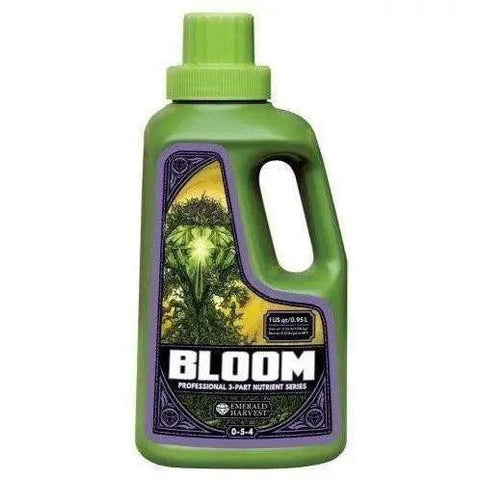

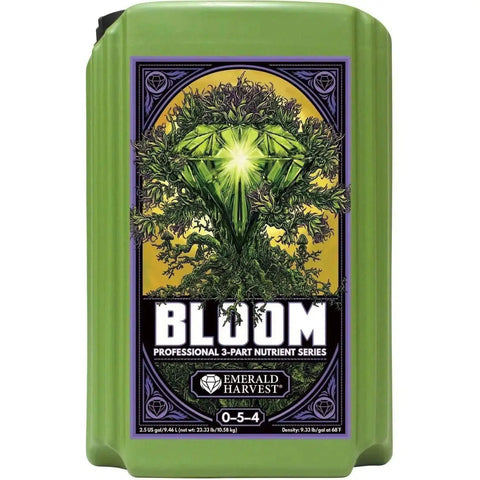

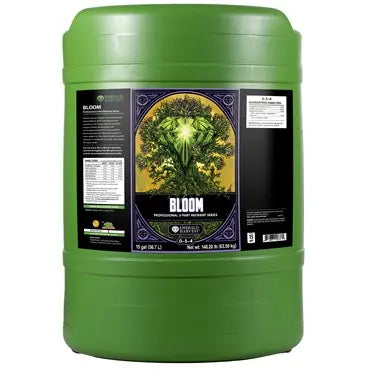
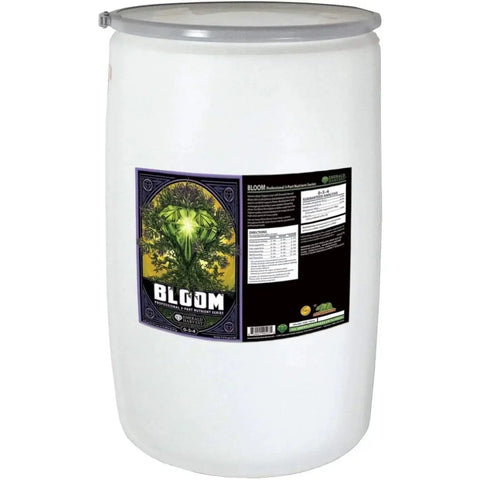
Emerald Harvest Bloom 0-5-4 3-Part Base Nutrient
Emerald Harvest Bloom 0-5-4 is the phosphorus- and potassium-rich flowering component of the Emerald Harvest Grow, Micro, Bloom Professional 3-Part Nutrient Series. Its concentrated mineral formula supports budding, flower and fruit development, energy transfer, plant metabolism, and timely crop maturation.
Bloom also supplies magnesium and sulfur from magnesium sulfate to support chlorophyll production, enzyme activity, and continued plant performance during demanding flowering stages. Its flexible three-part design allows experienced growers to adjust Grow, Micro, and Bloom independently as the crop’s nutritional needs change.
Emerald Harvest Bloom is not a complete stand-alone fertilizer. Use it with Emerald Harvest Micro and, when indicated by the feeding chart, Emerald Harvest Grow.
Key Benefits
- Flowering-stage nutrition: Supplies phosphorus and potassium to support budding, flowering, fruit formation, and ripening.
- Flexible three-part control: Allows Grow, Micro, and Bloom ratios to be adjusted independently throughout the crop cycle.
- Phosphorus support: Contributes to energy transfer, root activity, flower formation, and reproductive development.
- Potassium support: Helps regulate water movement, nutrient transport, carbohydrate production, and plant metabolism.
- Magnesium and sulfur: Supports chlorophyll production, photosynthesis, enzymes, and continued plant vigor.
- High-purity mineral sources: Formulated from monopotassium phosphate, potassium sulfate, and magnesium sulfate.
- Designed for productive crops: Provides stage-specific nutrition for high-yield flowering and fruiting plants.
- Hydroponic versatility: Suitable for growing media used in recirculating and drain-to-waste systems.
Guaranteed Analysis and Ingredients
- N-P-K: 0-5-4
- Available phosphate: 5%
- Soluble potash: 4%
- Derived from: Monopotassium phosphate, potassium sulfate, and magnesium sulfate
- Product type: Flowering component of a professional three-part base nutrient system
The magnesium and sulfur supplied by magnesium sulfate complement the primary and micronutrients delivered by Emerald Harvest Grow and Micro.
How the Three-Part System Works
The Emerald Harvest three-part program separates plant nutrition into three adjustable components:
- Grow 2-1-6: Supplies nitrogen and potassium for vigorous vegetative development.
- Micro 5-0-1: Provides nitrogen, calcium, and chelated micronutrients that support plant health throughout the crop cycle.
- Bloom 0-5-4: Supplies phosphorus, potassium, magnesium, and sulfur for flowering, fruiting, and ripening.
All three components are used in changing proportions according to the crop’s growth stage. Grow may be reduced or temporarily eliminated during late flowering, while Micro and Bloom continue supplying essential nutrition.
Official Bloom Application Rates
The Emerald Harvest three-part feeding chart recommends the following amount of Bloom per gallon of water:
- Seedlings and Cuttings: 2 mL per gallon
- Transplants: 1 mL per gallon
- Early Vegetative Growth: 2 mL per gallon
- Late Vegetative Growth: 2 mL per gallon
- Flowering Week 1 – Transition: 4 mL per gallon
- Flowering Weeks 2–3 – Early Flowering: 8 mL per gallon
- Flowering Weeks 4–5 – Mid Flowering: 10 mL per gallon
- Flowering Weeks 6–7 – Late Flowering: 11 mL per gallon
- Flowering Week 8 – Ripening: 11 mL per gallon
- Flowering Week 9 – Final Ripening: 2 mL per gallon
These are Bloom rates only. Add the corresponding amounts of Emerald Harvest Micro and Grow shown on the official three-part feeding chart.
Plant variety, source-water quality, lighting, environmental conditions, growing medium, and feeding intensity can affect the appropriate concentration. Monitor plants closely when following an aggressive feeding program.
Correct Mixing Instructions
- Fill the reservoir or watering container with fresh water.
- Shake each nutrient container thoroughly before measuring.
- Add Emerald Harvest Micro to the water first and mix completely.
- Add Emerald Harvest Grow when required by the feeding chart and mix again.
- Add Emerald Harvest Bloom at the appropriate stage-specific rate.
- Add compatible supplements individually, mixing between each addition.
- Check the final EC or PPM and pH before feeding.
Never combine undiluted Grow, Micro, and Bloom concentrates directly. Concentrated mineral nutrients can react with one another and form insoluble deposits.
Water Temperature and pH
Emerald Harvest recommends:
- Ideal nutrient-solution temperature: 60–72°F
- Ideal pH after mixing: 5.8–6.3
Complete the entire nutrient mixture before making pH adjustments. Add pH adjusters gradually and test between additions to avoid moving beyond the desired range.
Growing Media and System Compatibility
The Emerald Harvest three-part feeding chart is suitable for growing media used in:
- Recirculating hydroponic systems
- Drain-to-waste systems
- Coco coir
- Rockwool
- Deep water culture
- Flood-and-drain systems
- Drip irrigation and fertigation
- Other hydroponic and soilless applications
Adjust feeding strength to the crop, source water, growing medium, and system design.
Using It With Emerald Harvest Supplements
Emerald Harvest Bloom can be incorporated into a complete feeding program with supplements such as Emerald Goddess, King Kola, Honey Chome, Root Wizard, Cal-Mag, and Sturdy Stalk.
Follow the official Emerald Harvest chart when combining products, and monitor the total EC or PPM to avoid excessive nutrient strength. Emerald Harvest advises using Cal-Mag and Sturdy Stalk on water-only days and not applying both during the same watering.
Important Usage Notes
- Bloom is one component of the Grow, Micro, Bloom three-part series.
- Do not use Bloom as a complete stand-alone fertilizer.
- Always add Micro to fresh water before adding Grow or Bloom.
- Never premix concentrated nutrients.
- Measure each component separately according to the crop’s current growth stage.
- Monitor plants for signs of nutrient stress, deficiency, or overfeeding.
- Store tightly sealed under normal, temperature-controlled conditions.
