
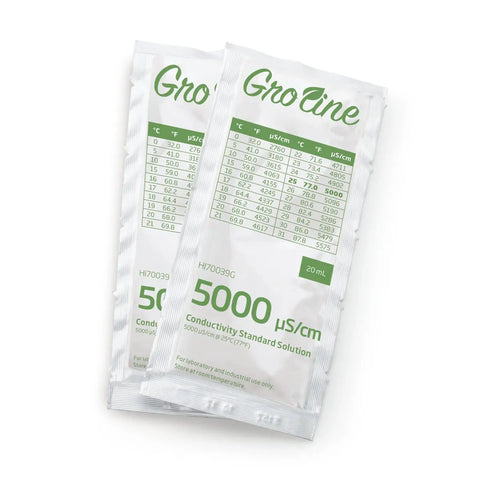
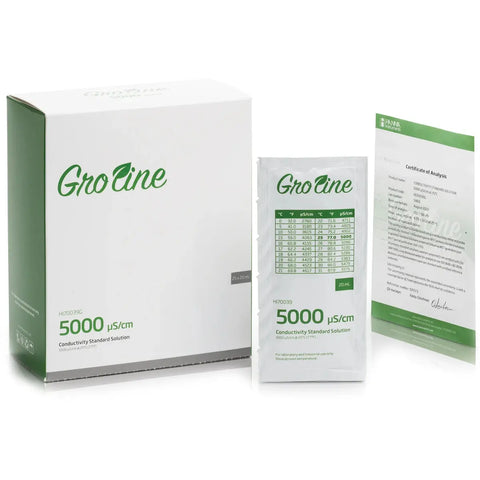
Hanna GroLine 5000 µS/cm Conductivity Standard Solution
Hanna GroLine 5000 µS/cm Conductivity Standard Solution provides a reliable reference point for calibrating compatible EC and TDS meters used in hydroponics, aquaponics, greenhouses, indoor gardens, and agricultural water testing. Accurate calibration helps growers confidently monitor concentrated nutrient solutions and maintain consistent feeding programs.
This premium conductivity standard is prepared using equipment calibrated with potassium chloride NIST 2202 Standard Reference Material. It is available in multiple packaging formats, allowing growers to select the option that best matches their testing frequency and calibration routine.
Key Benefits
- Higher-range calibration standard: Provides a 5,000 µS/cm reference point for compatible EC and TDS meters.
- Designed for growers: Ideal for testing hydroponic nutrients, aquaponic water, greenhouse irrigation, and fertigation solutions.
- Supports consistent readings: Routine calibration helps confirm that a meter is measuring conductivity correctly.
- NIST-traceable preparation: Standardized using equipment calibrated with potassium chloride NIST 2202 Standard Reference Material.
- Quality-controlled formulation: Prepared with deionized water for analytical use and precision laboratory equipment.
- Dye-free solution: Contains no added dyes that could stain sensitive probe components.
- Multiple format options: Choose the packaging style that best fits occasional or routine calibration needs.
- Portable and practical: Suitable for grow rooms, greenhouses, testing stations, and field use.
Product Specifications
- Manufacturer: Hanna Instruments
- Product line: GroLine
- Solution type: Conductivity calibration standard
- Conductivity value: 5,000 µS/cm at 25°C
- Equivalent value: 5.00 mS/cm at 25°C
- Traceability: Standardized using a conductivity meter calibrated with potassium chloride NIST 2202 SRM
- Preparation water: Deionized water for analytical use in accordance with ISO 3696/BS 3978
- Formulation: Dye-free
- Available formats: Bottle and single-use sachet options
- Intended instruments: Compatible EC and TDS meters that support a 5,000 µS/cm calibration point
Conductivity changes with temperature. The stated reference value of 5,000 µS/cm applies at 25°C. Follow the instrument manufacturer’s temperature-compensation and calibration instructions for the most accurate results.
Why Calibrate an EC or TDS Meter?
EC meters measure the electrical conductivity of a solution to help growers evaluate the concentration of dissolved ionic material. Compatible TDS meters use conductivity readings and a programmed conversion factor to estimate dissolved solids in parts per million.
Routine calibration helps confirm that the meter is interpreting conductivity correctly. Reliable measurements make it easier to prepare repeatable nutrient solutions, compare reservoir readings, recognize unexpected changes, and adjust feeding programs with greater confidence.
A 5,000 µS/cm standard is especially useful for compatible meters operating within higher conductivity ranges or measuring concentrated nutrient solutions. Confirm that the instrument supports this calibration point before use.
How to Use
- Confirm that the meter supports calibration at 5,000 µS/cm or 5.00 mS/cm.
- Allow the meter, conductivity probe, and calibration solution to reach the same stable temperature.
- Rinse the probe with distilled or deionized water.
- Gently shake off excess water without touching or damaging the sensing surfaces.
- Pour a fresh portion into a clean calibration vessel or open a single-use sachet, depending on the selected variant.
- Immerse the required sensing area in the calibration solution.
- Gently move or tap the probe to release trapped air bubbles.
- Follow the meter manufacturer’s instructions to complete calibration.
- Rinse the probe after calibration.
- Discard any solution that has contacted the probe.
Never return used calibration solution to its original container.
Compatible Applications
Hanna GroLine 5000 µS/cm Conductivity Standard Solution is suitable for compatible meters used in:
- Hydroponic nutrient reservoirs
- Aquaponic systems
- Greenhouses
- Indoor gardens
- Coco coir and soilless production
- Fertigation systems
- Irrigation-water testing
- Concentrated nutrient-solution preparation
- Agricultural water-quality monitoring
- Portable EC and TDS testing
Always verify that the instrument uses a 5,000 µS/cm or 5.00 mS/cm calibration point before purchasing.
Choosing a Format
Bottle variants are convenient for growers who calibrate meters regularly or maintain multiple instruments. Pour only the amount needed into a separate, clean calibration vessel to help protect the remaining solution from contamination.
Single-use sachets provide a fresh portion for each calibration session and are convenient for occasional use, field testing, or carrying with portable meters. Open a sachet immediately before use and discard the remaining solution afterward.
Storage and Handling
Store the calibration solution tightly sealed in a clean, dry location away from direct sunlight and extreme temperatures. Keep sachets sealed until immediately before use and close bottle containers promptly after dispensing.
Hanna formulates its conductivity standards for an expiration period of up to five years from the date of manufacture when unopened. Always follow the expiration date printed on the selected product. Do not use solution that is expired, visibly contaminated, or stored in damaged packaging.
Important Usage Notes
- Select the desired format from the available product variants.
- Do not dilute the calibration standard.
- Never return used solution to its original container.
- Do not combine fresh and previously used calibration solution.
- Use a clean calibration vessel when working with a bottle.
- Treat opened sachets as single-use products.
- A Certificate of Analysis is not included with individually sold sachets.
- Do not add calibration solution to a nutrient reservoir.
- Confirm meter compatibility with the 5,000 µS/cm calibration point.
- Follow the meter manufacturer’s instructions for temperature compensation and calibration.
