
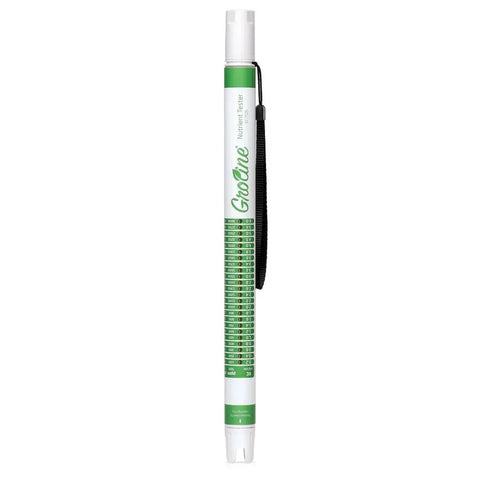
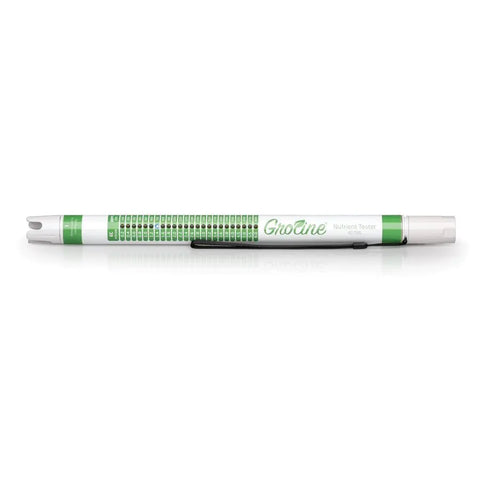
Hanna GroLine Nutrient EC/TDS Truncheon Tester HI98330
The Hanna GroLine Nutrient EC/TDS Truncheon Tester HI98330 is a rugged, waterproof meter designed for quick conductivity checks in hydroponic reservoirs, irrigation tanks, fertilizer solutions, and other agricultural applications. It measures electrical conductivity in mS/cm and displays the corresponding TDS concentration on both the 500 ppm and 700 ppm scales.
Simply place the tester in the nutrient solution and stir. The HI98330 turns on automatically, compensates for solution temperature, and displays the stabilized reading through 24 bright blue LEDs. Its extended measurement range supports everything from lighter seedling solutions to concentrated flowering and fruiting formulas.
Key Benefits
- Three measurement scales: Displays EC, 500-scale TDS, and 700-scale TDS simultaneously.
- Extended nutrient range: Measures EC up to 6.0 mS/cm, 3,000 ppm on the 500 scale, or 4,200 ppm on the 700 scale.
- No user calibration required: The tester is factory calibrated for straightforward operation.
- Automatic activation: Turns on when placed in a conductive nutrient solution.
- Automatic shutoff: Powers down 30 seconds after the measurement stabilizes.
- Temperature-compensated results: An integrated temperature sensor automatically compensates conductivity readings from 41–122°F.
- IP67 waterproof construction: Withstands temporary water immersion when the battery cap is correctly secured.
- Floating design: Floats for easier retrieval if accidentally released into a reservoir.
- Built for stirring: The durable truncheon-style body can stir the nutrient solution while taking a measurement.
- Highly visible LED scale: Uses 24 bright blue LEDs instead of a small digital display.
- Low-battery indication: Displays battery status when activated.
- Easy sensor access: The detachable crown-shaped cap simplifies cleaning around the graphite electrodes.
Why Measure EC and TDS?
Electrical conductivity indicates the concentration of dissolved ionic nutrients in water. Monitoring EC helps growers determine whether a nutrient solution is too weak, within the desired feeding range, or concentrated enough to increase the risk of fertilizer stress.
TDS expresses that conductivity as an estimated parts-per-million value. Because different nutrient manufacturers and meters use different conversion factors, the HI98330 displays both common TDS scales:
- 500 ppm scale: Converts EC using a 0.5 factor.
- 700 ppm scale: Converts EC using a 0.7 factor.
Always compare readings with the scale specified by the nutrient manufacturer or feeding chart. A result of 2.0 mS/cm corresponds to approximately 1,000 ppm on the 500 scale and 1,400 ppm on the 700 scale.
Measurement Specifications
- EC Range: 0.2–6.0 mS/cm
- EC Resolution: 0.1 mS/cm from 0.2–4.0 mS/cm
- High-Range EC Resolution: 0.25 mS/cm from 4.0–6.0 mS/cm
- 500-Scale TDS Range: 100–3,000 ppm
- 500-Scale TDS Resolution: 50 ppm from 100–2,000 ppm and 125 ppm from 2,000–3,000 ppm
- 700-Scale TDS Range: 140–4,200 ppm
- 700-Scale TDS Resolution: 70 ppm from 140–2,800 ppm and 175 ppm from 2,800–4,200 ppm
- Accuracy: ±4% of the reading plus one resolution point
- Calibration: Factory calibrated
- Temperature Compensation: Automatic from 41–122°F, or 5–50°C
- Operating Environment: 32–122°F, or 0–50°C
- Sensor Type: Graphite conductivity electrodes
- Display: 24 blue LEDs
- Enclosure Rating: IP67 waterproof and floating
- Power Supply: Three AA alkaline batteries
- Estimated Battery Life: Approximately three years at ten measurements per day
- Instrument Length: Approximately 17.5 inches
- Warranty: Six-year manufacturer warranty
Understanding the LED Display
The HI98330 has its EC and TDS scales printed directly on the tester body. Illuminated LEDs identify the measured nutrient concentration without requiring the user to switch between measurement modes.
When a reading falls between two marked values, two adjacent LEDs illuminate. The correct measurement is the midpoint between those values. For example, illumination at 3.2 and 3.4 mS/cm represents an EC reading of approximately 3.3 mS/cm.
Flashing LEDs indicate that the measurement is still stabilizing. Once the reading stabilizes, the LEDs remain steady and the tester begins its 30-second automatic shutoff period.
How to Use
- Remove the protective cap from the sensor end.
- Place the graphite electrodes into the nutrient solution.
- Use the tester to gently stir the solution.
- Make sure the sensor area is completely submerged and free from trapped air bubbles.
- Wait for the blue LED reading to stabilize.
- Read the EC, 500 ppm, or 700 ppm value from the printed scales.
- Remove the tester from the solution.
- Rinse the sensor area after use.
- Allow excess water to drain before replacing the cap.
A change in conductivity resets the automatic shutoff timer. To take another reading after the tester turns off, remove it from the solution and place it back into the liquid.
Best Practices for Reliable Measurements
- Mix the reservoir thoroughly before testing.
- Measure away from concentrated nutrient injection points.
- Avoid testing immediately after adding fertilizer.
- Allow nutrient concentrates to disperse completely before taking a final reading.
- Keep air bubbles from collecting between the graphite electrodes.
- Rinse the tester after every use to prevent fertilizer buildup.
- Compare results with the correct 500 ppm, 700 ppm, or EC feeding scale.
- Test source water before adding fertilizer when calculating the actual nutrient contribution.
- Use a clean conductivity standard periodically to verify performance.
The HI98330 is factory calibrated and does not provide a user-calibration procedure. If readings remain questionable after cleaning and verification with a fresh standard, contact Hanna Instruments for service guidance.
Cleaning and Maintenance
Quickly rinse the sensor end after each measurement to prevent fertilizer salts from accumulating between the graphite electrodes.
For more thorough cleaning:
- Rotate and remove the crown-shaped sensor cap.
- Rinse the exposed sensor area under running tap water.
- Use a soft-bristled brush and mild soapy surfactant to clean between the electrodes.
- Do not use abrasive materials or metal tools.
- Rinse thoroughly and shake off excess water.
- Allow the tester to dry before storage.
- Reinstall the protective cap.
Store the tester clean and dry. Unlike a glass pH electrode, the graphite EC sensors do not need to be stored in electrode storage solution.
Battery Replacement
The meter displays its battery status when activated. Replace the batteries when the low-battery warning appears, since nearly depleted batteries may affect measurement performance.
Use three matching 1.5-volt AA alkaline batteries. Do not combine old and new batteries or mix different battery brands. Secure the battery cap tightly after replacement to maintain the tester’s IP67 protection.
What Is Included
- Hanna GroLine HI98330 Nutrient EC/TDS Tester
- Three AA alkaline batteries
- Quick reference guide
- Instrument quality certificate
Important Usage Notes
- Measures EC and calculated TDS only; it does not measure pH.
- The integrated temperature sensor provides automatic compensation but does not display temperature.
- Use the correct TDS scale when comparing readings with a fertilizer schedule.
- The floating design assists with retrieval but does not make the HI98330 a continuous reservoir monitor.
- Remove the tester after taking a measurement and store it clean and dry.
- Ensure the battery compartment is fully closed before immersing the tester.
- Follow the current Hanna Instruments manual for operation, cleaning, battery replacement, and warranty service.
My 25 year old NZ Hydroponics International nutrient tester started to get somewhat not reliable.
I purchased the Hanna Groline nutrient tester as replacement.
I'm still attempting to get used to the calibration of the Hanna tester.
I compare the readings of my OLD nutrient tester with my New Hanna tester. My hope is that I can find the new tester EC as compared with my old tester CF to be consistent. So far it feels like I'm getting some consistent readings. If my comparisons and my documentation work out, I think the Hanna tester will work out for me. The Truncheon type of testers have been my friend for over 25 years. I have never calibrated or maintained them other than washing after use and changing batteries about every 5 years or so.
