
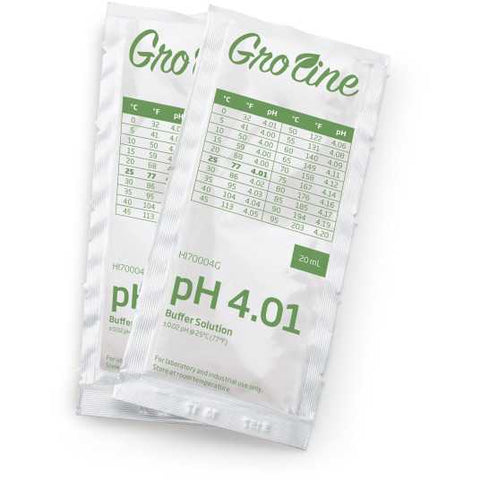
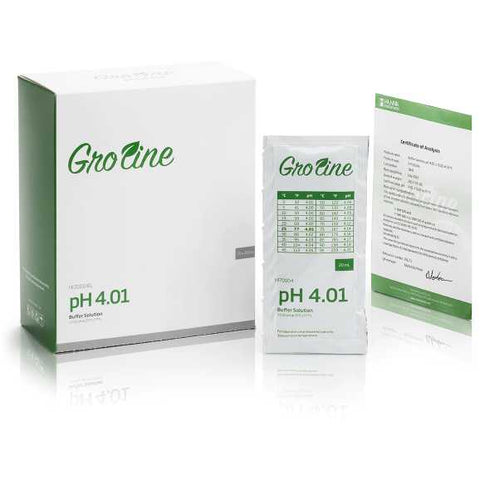
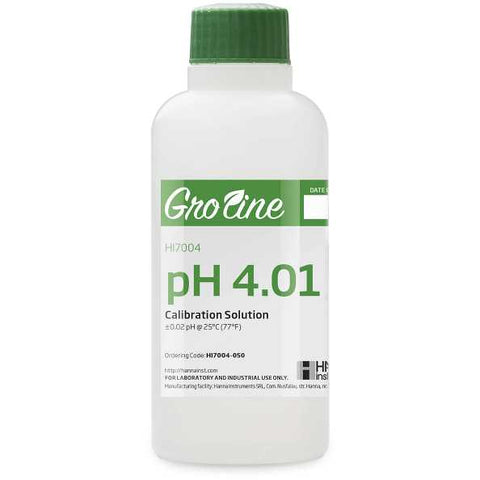
Hanna GroLine pH 4.01 Calibration Buffer
Hanna GroLine pH 4.01 Calibration Buffer is a high-quality, NIST-traceable solution formulated for accurate calibration of compatible pH testers, portable meters, monitors, and controllers. Designed for hydroponics, aquaponics, greenhouses, horticulture, and laboratory testing, it provides a reliable acidic reference point for measuring nutrient solutions, irrigation water, growing-media slurries, and other aqueous samples.
The buffer has an accuracy of ±0.02 pH at 25°C and is manufactured under controlled conditions using high-purity salts, deionized water, certified balances, Class A glassware, and certified thermometers. Its dye-free formulation helps prevent staining or contamination of the pH electrode’s reference junction.
Key Benefits
- Accurate pH 4.01 reference: Provides a dependable acidic calibration point for compatible pH instruments.
- NIST-traceable formulation: Values are traceable to National Institute of Standards and Technology Standard Reference Materials.
- Technical-grade accuracy: Rated at ±0.02 pH at 25°C.
- Professional manufacturing controls: Produced using high-purity ingredients and calibrated laboratory equipment.
- Dye-free solution: Contains no added colorants that could stain or contaminate sensitive electrode components.
- Two-point calibration support: Pairs with pH 7.01 buffer for accurate calibration across the acidic growing range.
- Broad meter compatibility: Suitable for Hanna Instruments and other pH meters designed to recognize pH 4.01 buffer.
- Horticultural applications: Ideal for meters used with hydroponic reservoirs, aquaponics, irrigation water, fertilizer solutions, soil slurries, and growing media.
- Multiple packaging options: Available variants accommodate occasional testing, routine maintenance, and higher-volume calibration programs.
Product Specifications
- Nominal Buffer Value: pH 4.01
- Accuracy: ±0.02 pH at 25°C
- Traceability: NIST-traceable
- Formulation: Technical calibration buffer
- Colorants: Dye-free
- Recommended Use: Acidic calibration point for compatible pH meters
- Manufacturing Standards: Produced using high-purity salts, deionized water, certified balances, Class A glassware, and temperature-controlled equipment
- Applications: Hydroponics, aquaponics, greenhouse production, horticulture, irrigation testing, soil and media testing, and laboratory measurements
Why Calibrate With pH 4.01 Buffer?
A pH meter calculates sample values by comparing the electrode’s response with known reference solutions. Routine calibration corrects for gradual changes caused by electrode aging, contamination, dehydration, temperature exposure, and repeated use.
The pH 4.01 buffer establishes the acidic calibration point commonly used for hydroponic and horticultural measurements. Because most nutrient solutions operate below neutral pH, calibrating with both pH 7.01 and pH 4.01 helps verify meter performance across the range growers are most likely to measure.
A single-point calibration at pH 7.01 may be suitable for routine checks, but a two-point calibration generally provides greater confidence when measuring acidic nutrient solutions.
Two-Point Calibration
For meters that support two-point calibration, pH 4.01 is commonly used with pH 7.01:
- Inspect the electrode for residue, salt deposits, or damage.
- Clean the electrode if necessary.
- Hydrate a dry electrode in proper storage solution before calibration.
- Pour fresh pH 7.01 buffer into a clean calibration container.
- Rinse the electrode with purified water and gently blot away excess droplets.
- Calibrate the meter at pH 7.01 according to its instructions.
- Rinse the electrode again.
- Place it into a fresh portion of pH 4.01 buffer.
- Allow the reading to stabilize and complete the second calibration point.
- Rinse the electrode before testing the sample.
Some instruments specify a different calibration sequence. Always follow the instructions supplied with the meter.
Calibration Best Practices
- Use fresh buffer for every calibration session.
- Pour only the amount needed into a clean container.
- Never pour used buffer back into its original package.
- Avoid placing a dirty electrode directly into a multi-use container.
- Rinse the electrode between different calibration standards.
- Gently blot the electrode instead of rubbing the glass bulb.
- Allow the buffer and electrode to reach a similar temperature before calibration.
- Keep containers closed when they are not in use.
- Replace buffer that appears cloudy, contaminated, discolored, or past its expiration date.
- Calibrate after cleaning the electrode or replacing the probe.
- Recalibrate whenever readings appear slow, unstable, or inconsistent.
Calibration Frequency
The appropriate calibration schedule depends on how frequently the meter is used, the required level of accuracy, and the condition of the electrode.
Consider calibrating:
- Before critical nutrient or irrigation measurements
- Weekly when the meter is used frequently
- Every few weeks during occasional use
- After cleaning or rehydrating the electrode
- After replacing the electrode
- After extended storage
- When readings become slow or unstable
- Whenever verification with a known buffer produces an unexpected result
Commercial growers, dosing-system operators, and users making frequent nutrient adjustments may benefit from more frequent calibration.
Temperature and Buffer Value
The stated pH 4.01 value applies at 25°C. Like other technical buffer solutions, its exact pH changes slightly with temperature.
Compatible meters with automatic temperature compensation account for temperature’s effect on electrode response. However, temperature compensation does not eliminate the buffer solution’s own temperature-dependent value. For high-accuracy applications, allow the probe and buffer to reach thermal equilibrium and use the temperature reference information supplied with the selected variant when available.
Preventing Contamination
Calibration buffer can become inaccurate when contaminated by:
- Nutrient solution carried on the electrode
- Residue from cleaning products
- Electrode storage solution
- Distilled or deionized rinse water
- Contact with another calibration buffer
- Dust, plant material, or growing-media particles
- Repeatedly returning used solution to its original container
Rinse the electrode thoroughly and remove excess rinse water before placing it in the buffer. Use a separate clean container when calibrating from a multi-use package.
Storage and Shelf Life
Store the buffer tightly closed in a cool, dry location away from direct sunlight, extreme heat, freezing temperatures, and contamination.
Unopened bottle variants are formulated for an expiration period of up to five years from the date of manufacture. Actual shelf life depends on the selected packaging format, storage conditions, lot number, and printed expiration date.
Use single-use packaging promptly after opening. Multi-use containers should be closed immediately after dispensing, and the solution should never be used past its marked expiration date.
Compatible Equipment
Hanna GroLine pH 4.01 Calibration Buffer can be used with compatible:
- Pocket pH testers
- Portable pH meters
- Continuous pH monitors
- Hydroponic nutrient monitors
- Automated pH dosing controllers
- Combination pH and EC meters
- Replaceable-electrode testers
- Laboratory pH meters
- Soil and growing-media pH testers
Confirm that the instrument supports automatic or manual calibration at pH 4.01 before use.
Important Usage Notes
- Calibration buffer is not intended to lower the pH of nutrient solutions.
- Do not add this product to a reservoir or irrigation tank as a pH adjuster.
- Do not use calibration buffer as an electrode storage solution.
- Never store a pH electrode in distilled, deionized, or reverse-osmosis water.
- Use Hanna electrode storage solution to keep the pH glass and reference junction hydrated.
- Discard buffer after it has been used for calibration.
- Certificate, temperature-chart, packaging, and shelf-life details may vary by selected variant.
- Follow the calibration instructions provided with the specific pH meter.
