
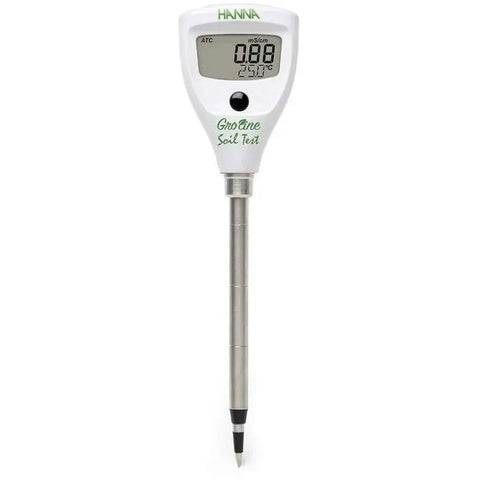
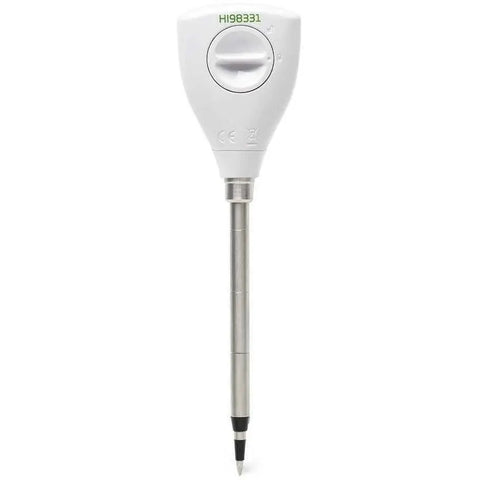
Hanna Soil Test Direct Soil EC & Temperature Tester HI98331
The Hanna Soil Test HI98331 is a portable electrical conductivity and temperature tester designed for direct measurement in moist soil and soilless growing media. Its stainless-steel penetration probe eliminates the need to prepare a soil slurry for routine testing, making it easier to monitor soluble-salt trends throughout a crop cycle.
The HI98331 is particularly useful for greenhouse crops, indoor gardens, nurseries, container plants, tropical houseplants, coco coir, peat-based mixes, and rockwool. By monitoring direct EC consistently, growers can identify increasing salt levels, compare fertilizer practices, and recognize developing root-zone problems before visible plant stress becomes severe.
Key Benefits
- Direct media testing: Insert the penetration probe into moist growing media without preparing a liquid slurry.
- Measures EC and temperature: Displays electrical conductivity and temperature for convenient root-zone monitoring.
- Stainless-steel penetration probe: Designed for insertion into soil, coco coir, peat mixes, rockwool, and similar media.
- Automatic temperature compensation: Applies a fixed 2% per °C coefficient to compensate EC readings for temperature.
- Automatic calibration: Performs a one-point calibration using a 1413 µS/cm conductivity standard.
- Simple operation: Compact design and single-button control make routine testing straightforward.
- Repeatable crop monitoring: Helps growers develop baseline EC ranges for their plants, media, and irrigation practices.
- Portable design: Suitable for greenhouse benches, indoor gardens, nurseries, raised beds, containers, and field sampling.
What the HI98331 Measures
Electrical conductivity indicates the ability of moisture within the growing media to conduct an electrical current. Conductivity generally increases as the concentration of dissolved fertilizer salts and other ions rises.
The HI98331 measures direct media EC. It does not measure individual nutrients, identify which salts are present, or directly report fertilizer concentration in ppm.
Direct EC Versus Nutrient-Solution EC
A direct measurement taken in growing media is not equivalent to measuring the EC of a hydroponic reservoir or freshly mixed nutrient solution.
Direct EC is influenced by:
- Moisture content
- Media composition
- Water-holding capacity
- Fertilizer distribution
- Testing depth
- Time since irrigation
- Drainage and evaporation
- Previous fertilizer or salt accumulation
Results will also differ from saturated-media extract, pour-through, and dilution or slurry testing methods. There is no universal conversion that accurately translates every direct reading into pore-water EC or nutrient-solution strength.
For meaningful results, compare readings taken from the same type of media using the same testing method and moisture conditions.
EC Specifications
- EC range: 0 to 4000 µS/cm
- Alternate EC range: 0.00 to 4.00 mS/cm or dS/m
- Resolution: 1 µS/cm or 0.01 mS/cm
- Accuracy from 0 to 2000 µS/cm: ±50 µS/cm
- Accuracy from 2000 to 4000 µS/cm: ±300 µS/cm
- Accuracy from 0.00 to 2.00 mS/cm: ±0.05 mS/cm
- Accuracy from 2.00 to 4.00 mS/cm: ±0.30 mS/cm
- Calibration: Automatic one-point calibration
- Calibration standard: 1413 µS/cm or 1.41 mS/cm
- Temperature compensation: Automatic with a fixed 2% per °C coefficient
Temperature Specifications
- Temperature range: 0.0 to 50.0°C / 32.0 to 122.0°F
- Temperature resolution: 0.1°C / 0.1°F
- Temperature accuracy: ±1°C / ±1.5°F
- Temperature sensor: Integrated into the penetration probe
Penetration Probe
The fixed HI73331 stainless-steel penetration probe is designed for direct insertion into moist media. Its narrow profile allows growers to test within the active root zone while minimizing disruption to containers and planted beds.
Create a pilot hole before testing compacted or coarse media. Do not force, pry, twist, or rock the probe through stones, dense roots, bark pieces, or other hard materials. Excessive sideways pressure may bend or damage the probe.
How to Calibrate
- Inspect the probe and remove any visible soil or fertilizer residue.
- Rinse the probe with distilled or deionized water.
- Dry the probe before placing it into the calibration standard.
- Pour fresh 1413 µS/cm conductivity standard into a clean container.
- Immerse the required portion of the probe in the standard.
- Enter calibration mode and allow the tester to recognize the standard.
- Wait for automatic calibration to complete.
- Rinse and dry the probe before returning to soil testing.
Never pour used calibration solution back into its original container. Calibration solution is sold separately unless specifically included in a retailer-created bundle.
How to Test Soil or Soilless Media
- Choose a representative testing location within the plant’s active root zone.
- Confirm that the media is evenly moist. Dry media will not provide the continuous moisture path required for dependable EC measurement.
- When possible, test near field capacity after excess irrigation water has drained.
- Use a ruler, probe guide, or auger to create a pilot hole and establish a consistent testing depth.
- Insert the stainless-steel probe straight into the media.
- Avoid twisting or applying sideways pressure.
- Allow the displayed EC and temperature readings to stabilize.
- Record the result, testing depth, media type, and time since irrigation.
- Take readings from at least three representative locations and calculate the average.
- Rinse and dry the probe after testing.
Best Practices for Repeatable Results
Hanna recommends testing when the media is close to field capacity. As a general guideline, this may be approximately 15 minutes after irrigation, once water has drained from larger pores and moisture has become more evenly distributed.
For useful trend data:
- Test the same media formulation each time.
- Measure at the same depth.
- Test at a consistent interval after irrigation.
- Take multiple readings and average the results.
- Keep fertilizer concentration and irrigation records.
- Compare each crop against its own established baseline.
- Note plant appearance, runoff EC, and environmental conditions.
- Avoid comparing direct readings with unrelated charts based on different extraction methods.
Consistency is more valuable than relying on a universal “ideal” number.
Interpreting Results
A rising direct EC trend may indicate increasing fertilizer concentration, insufficient runoff, uneven irrigation, or accumulated mineral salts. A falling trend may indicate reduced fertility, heavy leaching, lower fertilizer inputs, or increased nutrient uptake.
Always interpret the reading alongside:
- Plant species and growth stage
- Media composition
- Moisture level
- Irrigation frequency
- Fertilizer program
- Runoff percentage
- Plant appearance and vigor
- Previous readings from the same crop
Do not make a major fertilizer or flushing adjustment based on one isolated measurement.
Care and Maintenance
- Rinse the stainless-steel probe after every use.
- Remove soil and fertilizer residue before it dries.
- Dry the probe before storage.
- Avoid abrasive pads, harsh chemicals, and metal tools.
- Do not bend or pry with the penetration probe.
- Calibrate regularly with fresh conductivity standard.
- Replace calibration standard if it becomes cloudy or contaminated.
- Store the tester within its specified environmental range.
- Follow Hanna’s instructions when replacing the battery.
Unlike a glass pH electrode, this conductivity probe does not require pH electrode storage solution.
Additional Features
- Easy-to-read digital display
- Single-button operation
- Selectable automatic shutoff after 8 or 60 minutes
- Automatic shutoff can also be disabled
- Replaceable CR2032 battery
- Approximately 100 hours of continuous battery operation
- Operating environment up to 95% relative humidity, non-condensing
What Is Included
The Hanna HI98331 is supplied with:
- HI98331 Soil Test conductivity tester
- Fixed HI73331 stainless-steel penetration probe
- Calibration screwdriver
- Battery
- Operating instructions
Conductivity calibration solution may be required separately.
Important Limitations
The HI98331 measures EC and temperature. It does not measure soil pH, moisture percentage, individual nutrient concentrations, TDS in ppm, or specific fertilizer elements.
Because moisture content strongly affects direct conductivity measurements, dry-media readings should not be compared with readings taken near field capacity. Measurements from different media types or different extraction methods are also not directly interchangeable.
