
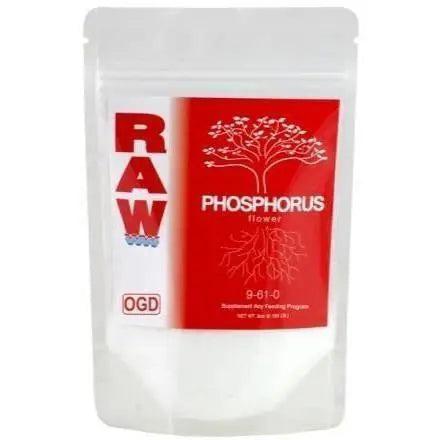
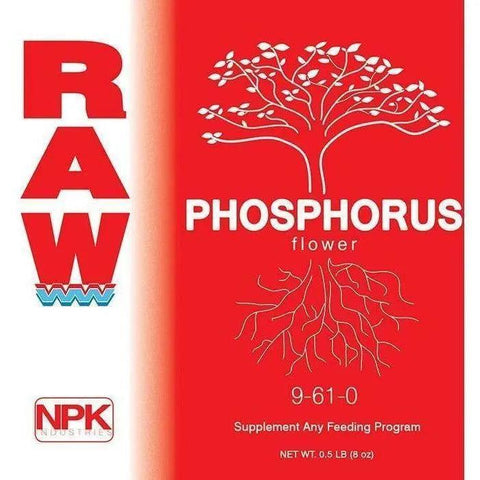
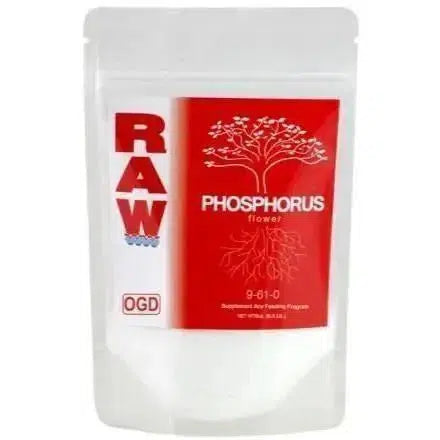

NPK Industries RAW Phosphorus 9-61-0
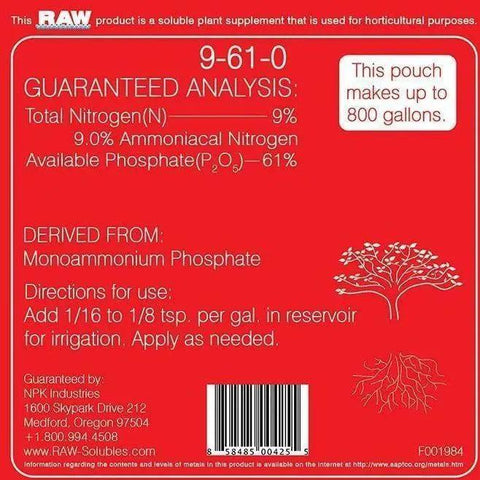
NPK Industries RAW Phosphorus 9-61-0 is a highly concentrated, completely water-soluble fertilizer supplement formulated for precise phosphorus adjustment. Derived from monoammonium phosphate, it supplies 61% available phosphate as P₂O₅ and approximately 9% ammonium nitrogen to support root establishment, cellular energy transfer, and reproductive plant development.
RAW Phosphorus can be incorporated into soil, coco coir, and hydroponic nutrient programs. Its single-source formulation gives experienced growers greater control over phosphorus levels without introducing potassium or a broad mixture of unrelated ingredients.
Key Benefits
- Concentrated phosphorus source: Supplies 61% water-soluble available phosphate as P₂O₅.
- Root-development support: Helps meet phosphorus demand during early root establishment and transplant development.
- Plant energy transfer: Phosphorus is essential for ATP and ADP, which plants use to transfer energy throughout metabolic processes.
- Flower and fruit nutrition: Supports normal flowering, fruit set, seed formation, and reproductive development when phosphorus is limiting.
- Ammonium nitrogen: Provides approximately 9% nitrogen in an immediately available ammonium form.
- Deficiency correction: Allows targeted phosphorus adjustment without adding potassium.
- Complete solubility: Dissolves fully for clean use in irrigation water, hydroponic reservoirs, and custom fertilizer solutions.
- Flexible application: Suitable for soil, coco coir, hydroponic, fertigation, and manufacturer-approved foliar programs.
- Custom nutrient control: Works with compatible base fertilizers and individual RAW soluble products.
Guaranteed Analysis and Formulation
- N-P-K analysis: 9-61-0
- Nitrogen: Approximately 9% ammonium nitrogen
- Available phosphate: 61% P₂O₅
- Derived from: Monoammonium phosphate
- Water solubility: 100%
- Form: Concentrated dry soluble crystals or powder
- Product type: Individual phosphorus fertilizer supplement
RAW Phosphorus does not contain potassium and is not a complete fertilizer. Use it with an appropriately balanced nutrient program unless correcting a specifically identified phosphorus shortage.
Understanding the 9-61-0 Analysis
The middle number in the 9-61-0 analysis represents available phosphate reported as P₂O₅, the standard fertilizer-label measurement. It does not mean that the product contains 61% elemental phosphorus.
Because the formula is highly concentrated, small changes in application rate can substantially affect reservoir strength and nutrient balance. Measure carefully and begin with the lowest appropriate rate.
Role of Phosphorus in Plants
Phosphorus contributes to several essential plant functions:
- Root initiation and early establishment
- ATP and ADP energy transfer
- Photosynthesis and carbohydrate metabolism
- Cell division and tissue development
- Flower, fruit, and seed formation
- Movement and storage of energy within the plant
Adding excess phosphorus does not automatically increase flowering or yield. The best results occur when phosphorus is balanced with nitrogen, potassium, calcium, magnesium, sulfur, and trace elements.
Official RAW Custom Feeding Schedule
The current NPK Industries chart lists the following rates per gallon of water for custom nutrient programs:
- Vegetative Weeks 1–4: ⅛ teaspoon per gallon
- Flowering Weeks 1–2: ½ teaspoon per gallon
- Flowering Week 3: ¼ teaspoon per gallon
- Flowering Weeks 4–7: ⅛ teaspoon per gallon
- Final Week or Flush: Discontinue use
These rates are intended for building a custom fertilizer program and are not directions to use every individual RAW product simultaneously. Consider the phosphorus already supplied by the base fertilizer before adding the full chart rate.
Plant variety, source water, growing medium, environmental conditions, and total nutrient concentration may require a lower application rate. Begin lightly and monitor EC, PPM, pH, runoff, and plant response.
Correcting a Phosphorus Deficiency
Possible phosphorus-deficiency symptoms can include slow growth, weak root development, unusually dark foliage, or purple coloration on stems and older leaves. However, similar symptoms can also result from cold root zones, genetics, improper pH, overwatering, root damage, or excessive fertilizer concentration.
Before increasing phosphorus:
- Confirm that the root-zone temperature is appropriate.
- Check the nutrient solution and runoff pH.
- Inspect roots and irrigation practices.
- Review the phosphorus already supplied by the base fertilizer.
- Apply a low corrective rate and observe new growth.
Correct the underlying environmental or root-zone problem when phosphorus is present but unavailable.
Recommended Mixing Instructions
- Begin with clean water in the reservoir or mixing container.
- Measure RAW Phosphorus carefully using an accurate scale or measuring spoon.
- Dissolve it completely in water before adding other fertilizer products.
- Add compatible base nutrients and supplements separately, mixing thoroughly after each addition.
- Check the completed solution’s EC or PPM.
- Measure and adjust pH only after every fertilizer component has been added.
- Apply the finished solution promptly.
Never dry-mix RAW Phosphorus with other fertilizer salts. Do not combine concentrated phosphate directly with concentrated calcium products, as insoluble mineral deposits can form. Always dilute each component thoroughly in water.
Using It With a Base Fertilizer
RAW Phosphorus can supplement a wide variety of mineral and organic-based feeding programs, but the base fertilizer’s existing phosphorus content must be considered.
When using a complete fertilizer such as RAW Grow or RAW Bloom, additional phosphorus may be unnecessary unless the crop, water analysis, tissue testing, or visible plant response indicates a need. Reduce the supplemental rate when other bloom boosters or high-phosphate products are present.
Monitor total EC or PPM rather than treating individual additives as though they do not contribute to overall fertilizer strength.
Vegetative and Root Development
Phosphorus is especially important during early establishment, when plants are developing new roots and preparing the structural framework for later growth. RAW Phosphorus can be incorporated at a low rate during vegetative growth when the base program does not provide adequate phosphate.
Avoid excessive early phosphorus. More fertilizer does not necessarily produce more roots, and overly high concentrations can interfere with the availability of zinc, iron, and other micronutrients.
Flowering and Fruiting
During flowering and fruiting, phosphorus supports energy transfer and normal reproductive development. The official RAW chart uses its highest phosphorus concentration during the first two flowering weeks and then gradually reduces the rate.
RAW Phosphorus should be treated as a precision nutrient input rather than a universal bloom booster. Plants that already receive sufficient phosphorus may not benefit from additional supplementation.
Foliar Application
The manufacturer lists RAW Phosphorus as foliar compatible. Because the current product page does not publish a universal foliar dilution rate, follow the package label or a current manufacturer program for foliar mixing instructions.
Test a small section of foliage before widespread application. Apply under low-intensity lighting, provide adequate air movement, and avoid spraying open flowers or fruit intended for immediate harvest.
Growing Media and System Compatibility
RAW Phosphorus is suitable for:
- Soil and living-soil programs
- Coco coir
- Soilless growing media
- Hydroponic reservoirs
- Deep water culture
- Drip irrigation and fertigation
- Flood-and-drain systems
- Nutrient film technique
- Aeroponics
- Regular hand-watering programs
Always confirm that the completed fertilizer solution is appropriate for the crop and irrigation equipment.
Important Usage Notes
- This is a concentrated phosphorus supplement, not a complete base fertilizer.
- Measure carefully and begin with the lowest suitable rate.
- Account for phosphorus supplied by every other fertilizer and additive.
- Do not use all individual RAW products at their maximum rates simultaneously.
- Never combine dry fertilizer salts or concentrated nutrient solutions directly.
- Excess phosphorus can disrupt micronutrient availability.
- Keep the container tightly sealed and protect the powder from moisture.
- Store in a cool, dry location away from direct sunlight.
- Keep out of reach of children and avoid breathing airborne fertilizer dust.
