
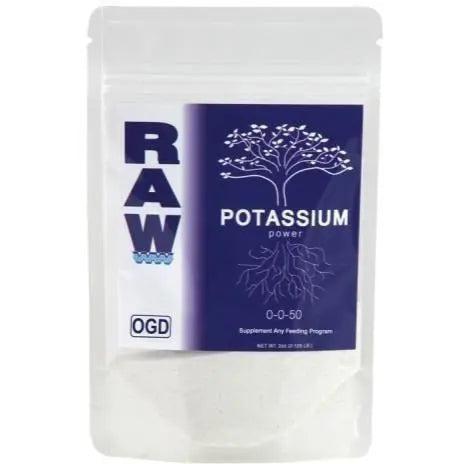
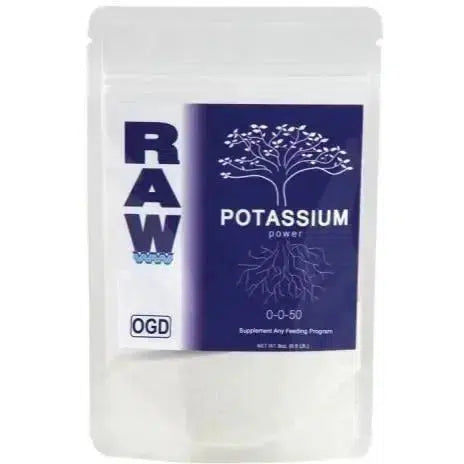

NPK Industries RAW Potassium 0-0-50
NPK Industries RAW Potassium 0-0-50 is a highly concentrated, completely water-soluble potassium supplement formulated for precise nutrient adjustment. Derived from sulfate of potash, it supplies 50% soluble potash as K₂O to support nutrient transport, water regulation, enzyme activity, stress tolerance, and productive flower and fruit development.
RAW Potassium can be incorporated into soil, coco coir, hydroponic, and foliar feeding programs. Its single-source formula allows growers to increase potassium without adding nitrogen or phosphorus, making it useful for correcting deficiencies and fine-tuning custom nutrient recipes.
Key Benefits
- Concentrated potassium source: Supplies 50% water-soluble potash reported as K₂O.
- Flower and fruit support: Helps plants meet increased potassium demand during flowering, fruit development, and ripening.
- Nutrient transport: Supports the movement of water, sugars, carbohydrates, and minerals throughout plant tissues.
- Enzyme activation: Potassium helps regulate numerous enzymes involved in plant metabolism and growth.
- Water regulation: Supports stomatal function and the plant’s ability to manage water efficiently.
- Stress tolerance: Helps plants respond to drought, salinity, heat, and other environmental challenges.
- Crop-quality support: Contributes to normal fruit firmness, color, aroma, flavor, and overall plant quality.
- Targeted formulation: Adds potassium without introducing nitrogen or phosphorus.
- Complete solubility: Dissolves cleanly for use in reservoirs, irrigation systems, and custom fertilizer solutions.
- Flexible compatibility: Suitable for soil, coco coir, hydroponic, fertigation, and manufacturer-approved foliar programs.
Guaranteed Analysis and Formulation
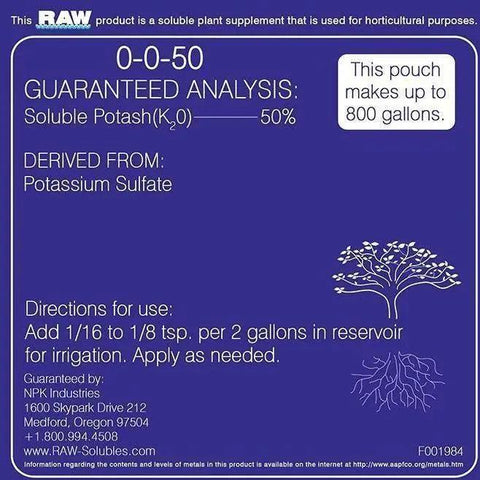
- N-P-K analysis: 0-0-50
- Soluble potash: 50% K₂O
- Derived from: Sulfate of potash, also known as potassium sulfate
- Nitrogen: 0%
- Available phosphate: 0%
- Water solubility: 100%
- Form: Concentrated soluble crystals or powder
- Product type: Individual potassium fertilizer supplement
Sulfate of potash provides potassium in a sulfate-based form rather than a potassium-chloride fertilizer source. RAW Potassium is not a complete plant fertilizer and should be used with a properly balanced nutrient program.
Understanding the 0-0-50 Analysis
The third number in the 0-0-50 analysis represents soluble potash expressed as K₂O, the standard fertilizer-label measurement. It does not mean that the product contains 50% elemental potassium.
Because RAW Potassium is highly concentrated, small changes in dosage can substantially affect the fertilizer solution’s potassium level and overall EC. Measure carefully and begin at the lowest appropriate rate.
Role of Potassium in Plants
Potassium supports several essential plant processes:
- Movement of water and dissolved nutrients
- Transport of sugars and carbohydrates
- Stomatal opening and closing
- Enzyme activation
- Photosynthesis and energy management
- Stem and tissue strength
- Flower and fruit development
- Plant response to environmental stress
Potassium does not become part of plant structures in the same way as nitrogen or calcium. Instead, it acts as an important regulator that helps numerous physiological processes function efficiently.
General Application Rate
For root-zone irrigation, mix:
- Routine Supplementation: 1/16 teaspoon per gallon of water
- Higher-Demand or Corrective Application: Up to 1/8 teaspoon per gallon
- Frequency: Apply as needed while monitoring plant response and total nutrient strength
- Final Flush: Discontinue along with other fertilizer inputs
The lower rate is generally appropriate when supplementing an existing nutrient program. Use the higher rate cautiously when correcting an identified potassium deficiency or meeting increased demand during productive flowering and fruiting.
These are supplemental rates. Account for potassium already supplied by base fertilizers, bloom boosters, silica products, and other additives before applying RAW Potassium.
Correcting a Potassium Deficiency
Potassium-deficiency symptoms commonly begin on older leaves and may include:
- Yellowing along leaf margins
- Brown or scorched leaf edges
- Dark or rust-colored spotting
- Weak stems or reduced plant vigor
- Poor flower or fruit development
- Reduced tolerance to heat or drought
Similar symptoms can also result from excessive fertilizer strength, improper pH, root damage, calcium or magnesium imbalance, drought stress, or salt buildup.
Before increasing potassium, inspect the root system, confirm the root-zone pH, check input and runoff EC, and review every potassium-containing product already in the feeding program.
Recommended Mixing Instructions
- Begin with clean water in the reservoir or mixing container.
- Measure RAW Potassium accurately.
- Dissolve the powder completely in a separate portion of water.
- Add the dissolved solution to the reservoir and mix thoroughly.
- Add compatible base nutrients and supplements separately, stirring between additions.
- Check the completed solution’s EC or PPM.
- Measure and adjust pH only after all fertilizer products have been added.
- Apply the finished solution promptly.
Never dry-mix RAW Potassium with other fertilizer salts. Do not combine concentrated potassium sulfate directly with concentrated calcium fertilizers, as insoluble mineral deposits may form. Dilute every component thoroughly in water.
Using It With a Base Fertilizer
RAW Potassium can supplement many mineral, organic-based, and custom fertilizer programs. Review the base fertilizer’s guaranteed analysis before adding it, as many bloom nutrients and complete fertilizers already contain substantial potassium.
When using RAW Grow, RAW Bloom, or another complete fertilizer, additional potassium should be applied only when crop demand, plant response, water analysis, or a custom nutrient recipe indicates a need.
Monitor the total fertilizer concentration rather than treating individual additives as though they do not contribute to EC or PPM.
Flowering and Fruiting Applications
Potassium demand often increases as plants develop flowers and fruit. RAW Potassium can help maintain appropriate potassium levels during these productive stages without adding nitrogen or phosphorus.
Adequate potassium supports normal sugar movement, water regulation, fruit firmness, aroma, color, and ripening. However, adding more potassium than plants require does not automatically produce larger flowers or higher yields.
Balancing Potassium With Calcium and Magnesium
Potassium, calcium, and magnesium compete for uptake within the root zone. Excessive potassium can interfere with calcium and magnesium availability even when those minerals are present in the fertilizer solution.
Monitor plants for calcium or magnesium symptoms when increasing potassium, especially in coco coir, reverse-osmosis water, and intensive hydroponic programs. Maintain a balanced nutrient profile rather than correcting one element at the expense of another.
Foliar Application
The manufacturer lists RAW Potassium as foliar compatible. Because the current product page does not provide a universal foliar dilution rate, follow the package label or a current manufacturer recipe for foliar application.
Test the solution on a small area before treating the entire crop. Apply under low-intensity lighting with adequate airflow, and avoid spraying open flowers or produce intended for immediate harvest.
Growing Media and System Compatibility
RAW Potassium is suitable for:
- Soil gardens
- Coco coir
- Soilless growing media
- Hydroponic reservoirs
- Deep water culture
- Drip irrigation and fertigation
- Flood-and-drain systems
- Nutrient film technique
- Aeroponics
- Regular hand-watering programs
Always verify that the finished nutrient concentration is appropriate for the crop, growth stage, and irrigation equipment.
Important Usage Notes
- RAW Potassium is a concentrated supplement, not a complete base fertilizer.
- Measure carefully and begin with the lowest suitable rate.
- Account for potassium supplied by every other fertilizer and additive.
- Excess potassium can interfere with calcium and magnesium uptake.
- Do not use all individual RAW products at maximum strength simultaneously.
- Never combine dry salts or concentrated fertilizer solutions directly.
- Monitor EC, PPM, pH, runoff, and plant response.
- Keep the container sealed and protect the powder from moisture.
- Store in a cool, dry location away from direct sunlight.
- Keep out of reach of children and avoid breathing fertilizer dust.
A little bit will go a long ways. Make sure you have measuring spoons that do smaller amounts.
