
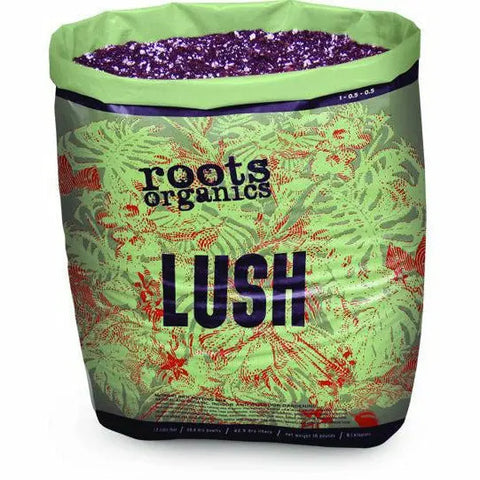
Roots Organics Lush Living Soil Growing Mix
Roots Organics Lush is a heavily amended, ready-to-use peat-based growing mix designed for gardeners who want rich organic nutrition with a water-only or reduced-nutrient feeding schedule. This premium super soil combines peat moss, coco fiber, perlite, pumice, earthworm castings, and a robust amendment package to create a balanced root-zone environment with excellent moisture retention, drainage, and aeration.
Packed with natural and organic ingredients, Roots Organics Lush helps support vigorous growth, strong roots, active soil biology, and productive flowering plants. Its nutrient-rich formula can feed many plants for up to eight weeks without additional support, making it a great choice for container gardens, fabric pots, raised planters, indoor gardens, greenhouses, and growers looking for a simplified organic soil program.
Key Benefits
Heavily Amended Super Soil
Loaded with natural organic amendments such as bat guano, feather meal, fishbone meal, soybean meal, fish meal, alfalfa meal, crab meal, blood meal, seaweed meal, greensand, volcanic rock dust, leonardite, hop flowers, and nettle leaf.
Water-Only or Reduced-Nutrient Growing
Designed to provide strong initial fertility, allowing many plants to grow with plain water or reduced nutrient inputs for several weeks after transplanting.
Excellent Drainage & Moisture Balance
The peat, coco, perlite, pumice, and worm casting base creates a consistent structure with strong water-holding capacity, quick drainage, and root-zone oxygen flow.
Contains Beneficial Microbes & Mycorrhizae
Includes beneficial Bacillus bacteria and mycorrhizal fungi to help support nutrient availability, root development, and overall soil health.
Great for Mature & Heavy-Feeding Plants
Formulated with a strong organic amendment package to support vigorous plants through early establishment, vegetative growth, and the transition into flowering.
Ready to Use in Containers or Grow Bags
Use directly in rigid pots, fabric containers, raised planters, or even plant directly into the bag with proper drainage holes.
What Makes Roots Organics Lush a Living Soil?
Roots Organics Lush is more than just potting soil — it is a living soil designed to create an active root-zone ecosystem. Instead of relying only on bottled nutrients, living soil uses organic amendments, beneficial microbes, mycorrhizal fungi, and natural mineral inputs to help feed the soil so the soil can feed the plant.
The included beneficial bacteria and mycorrhizae help break down organic ingredients into plant-available nutrients over time, supporting stronger roots, improved nutrient uptake, and healthier plant growth. This makes Lush a great choice for growers who want a more natural, soil-first approach with water-only or reduced-nutrient feeding.
Because living soil works best when microbial life is protected, avoid letting the soil fully dry out for long periods and avoid harsh synthetic chemicals that may disrupt beneficial biology. For best results, keep the soil evenly moist, use quality water, and consider pairing with compost teas, microbial inoculants, or organic top dressings as the initial nutrient charge begins to fade.
How to Use Roots Organics Lush
Container Planting:
Pour Roots Organics Lush directly into a rigid pot, fabric container, or grow bag with adequate drainage.
In-Bag Growing:
Cut the top off the 1.5 cu ft bag, poke drainage holes in the bottom, and plant directly into the bag.
Transplanting:
Place the root ball into the media, backfill gently, and avoid overcompacting the soil so roots can breathe.
Initial Watering:
Immediately after transplanting, saturate thoroughly with plain water or a light starter nutrient solution.
Long-Term Feeding:
Water normally and monitor plant response. As the initial fertility charge begins to taper off, transition into organic bloom nutrients, top dressing, compost teas, or supplemental feeding as needed.
Always adjust watering and feeding based on plant size, container size, environment, growth stage, and plant response.
Roots organic is my go to for living soil, it has everything my plants need to go through veg growth, it works great in my auto pot system
Works great. Only add water
