
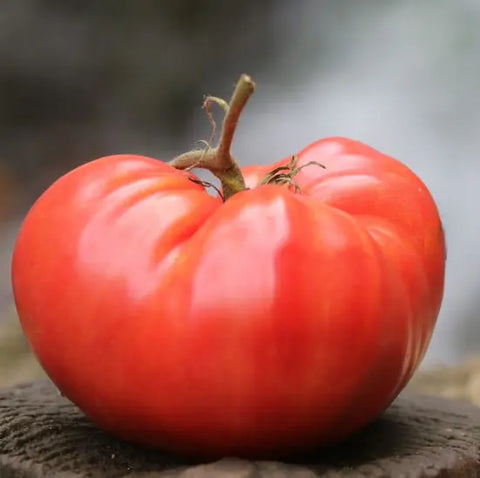
Seed Savers Exchange Tomato, German Pink (Organic)
Seed Savers Exchange
Tomato, German Pink (Organic)
Solanum lycopersicum
- Organic
- Packet of 25 Seeds
The ‘German Pink’ tomato is a Bavarian heirloom and one of the two seeds that started it all at Seed Savers Exchange. Its potato leaf plants produce large 1-2 pound beefsteak fruits with very few seeds, a creamy texture, and are crack-resistant. It is an indeterminate variety, continuing to provide a steady harvest throughout the season.
Slow Foods USA Ark of Taste praised its flavor, calling it “a full sweet… even floral.” With gorgeous pink fruit, this heirloom tomato is versatile, excellent for canning and freezing, but also for slicing and juicing.
The ‘German Pink’ tomato holds a special place in Seed Savers Exchange’s history.
Growing Habits
Choose a sunny location with 6-8 hours of direct sunlight daily. Use stakes, cages, or trellises to support the plant and its heavy fruit.
How to Harvest
Inspect your plants daily, as ripeness is a continuous process, and you don’t want to miss any ripe tomatoes or let them overripen. To increase yields, harvest frequently. Tomatoes may also be harvested at the “breaking point,” right when they start to change color, and will continue to ripen off the vine. This will tell the tomato plant to put its energy into developing more fruit instead of just ripening the current ones, which can increase your overall yield.
Store your tomatoes at room temperature. The flavor and texture of tomatoes suffer when the fruit is chilled.
How to Use
The ‘German Pink’ tomato is excellent for canning, freezing, slicing, and juicing. “The first ripe ‘German Pink’ tomatoes in late August in Iowa were always worth the wait,” says Diane Ott Whealy, co-founder of Seed Savers Exchange. “These tomatoes needed no fancy recipe to be enjoyed; we usually ate the thick slices just sprinkled with sugar, served on a large white plate. Today, everyone wants to add feta, basil, olive oil, and other embellishments, but these tomatoes don’t need any embellishment.”
History of the Variety
Here at Heritage Farm—the Northeast Iowa home of Seed Savers Exchange—the ‘German Pink’ tomato is perhaps better known as “tomato number one” or “the tomato that started it all.”
Today, Seed Savers Exchange stewards approximately 20,000 heirloom varieties, including thousands of tomato varieties. But Diane Ott Whealy and Kent Whealy founded the organization in 1975 with just two—‘Grandpa Ott’s’ Morning Glory and the ‘German Pink’ tomato, a legacy Amy Goldman, Seed Savers Exchange special advisor, recounts in her book The Heirloom Tomato (which features the ‘German Pink’ on its cover):
“Diane Ott Whealy’s paternal great-grandfather, Michael Ott, carried the seed with him from Bremen, Germany, on board the SS Main. He set foot on U.S. soil on November 3, 1883; three months later, in West Union, Iowa, he filed an ‘Intention to Become an American Citizen,’” she writes. “One can suppose he planted saved seeds that first Iowa spring, claiming American citizenship for the tomato now known as ‘German Pink’ and for ‘Grandpa Ott’s’ Morning Glory—the two varieties with which Seed Savers Exchange was eventually founded…thus ensuring the survival of their own treasured seeds and those of thousands of other gardeners.” The ‘German Pink’ tomato was introduced into the Seed Savers Exchange catalog as a From the Collection variety in 1999.
Learn To Grow It
Instructions - Sow seeds indoors ¼" deep. Tomatoes are sensitive to freezing temperatures, so wait to transplant outdoors until the soil is warm—plant in full sun. Water your plants at their base to avoid wetting the leaves, which will foster fungal diseases.
- Start Indoors: 6 weeks before the last frost.
- Germination: 7-14 days.
- Plant Outdoors: 24-36” apart.
- Support: Cage, stake, or trellis.
- Under ideal conditions, they mature in 10-12 weeks from transplant.
If saving seed, tomatoes require 10-50 feet of isolation to avoid cross-pollination. A single tomato plant can produce viable seed. To maintain the variety’s health over time, save seeds from between 5 and 10 plants.
