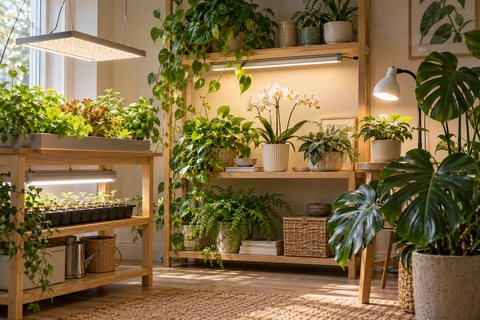
Grow Lights for Tropical Plants: Where to Start
Your monstera has stopped producing larger leaves. Your pothos is reaching toward the window. Your orchid looks healthy but hasn’t flowered again. Before adding more fertilizer, take a closer look at the light.
Grow lights for tropical plants can supplement a dim window, brighten a plant shelf, or create a growing area where natural light falls short. The best setup depends on the plant, the amount of daylight already available, and how much foliage your fixture needs to cover.
Monstera, pothos and orchids can all grow under artificial light, but they shouldn’t automatically receive the same intensity. Start with the plant’s needs, then choose the fixture.
Quick Guide to Tropical Plant Lighting
| Plant | Practical light goal | Useful grow-light options |
|---|---|---|
| Monstera deliciosa | Bright, filtered light reaching the upper canopy | Adjustable LED panel or suitably positioned grow bulb |
| Pothos | Bright, indirect light for fuller growth; tolerates lower light | LED bars for shelves or a grow bulb for one plant |
| Phalaenopsis orchid | Bright, gentle light without harsh direct sun | LED bars, suitable T5 fixtures, or adjustable grow lights |
Pothos tolerates low light, while monstera generally benefits from a brighter position. For orchids, identify the type first: the common Phalaenopsis—or moth orchid—has different requirements from higher-light orchids such as many cattleyas. plants.ces.ncsu.edu
What Does Bright, Indirect Light Actually Mean?
Bright, indirect light describes a well-lit location where strong sunlight isn’t striking the leaves directly for extended periods.
A window’s direction is only part of the picture. Trees, neighboring buildings, screens, curtains and the distance between the plant and the glass all affect how much light reaches the foliage. A bright room can still contain a surprisingly dim plant corner.
Observe the plant’s actual position at different times of day. In Green Bay and other northern climates, reassess that spot as autumn days shorten and winter approaches.
Artificial lighting gives you another way to adjust the growing space instead of continually moving plants between windows.
How Much Light Does a Monstera Need?
Monstera deliciosa prefers moderate brightness without harsh direct sunlight. Variegated cultivars generally need more light than darker green forms, but additional light should be introduced gradually. NC State University
For a large monstera, coverage matters. A narrow beam aimed at one leaf may leave much of the canopy shaded. Position the fixture so it reaches the main growing area, and reassess as the plant climbs or produces taller leaves.
LED grow light panels are worth considering for a broad canopy or a grouped plant display. Look for adjustable output and coverage information rather than choosing the most powerful fixture available.
Light also isn’t the only factor behind mature leaf shape. Plant age, support and overall care matter, so adding a grow light does not guarantee immediate leaf splits.
How Much Light Does Pothos Need?
Pothos prefers bright, indirect light even though it can survive for long periods in lower-light conditions. That tolerance makes it adaptable, but a dark corner should not be confused with an ideal growing location. plants.ces.ncsu.edu
When lighting a trailing pothos, pay attention to the foliage near the pot as well as the hanging vines. A lamp below the plant may illuminate the trailing ends while leaving the main growing area in shadow.
LED grow light bars are a practical option for shelves. Position them to illuminate the plant area beneath the shelf and check whether neighboring plants block the light.
For a single tabletop pothos, a properly positioned grow bulb may offer a simpler solution.
How Much Light Do Orchids Need?
“Orchid” describes a large group of plants, not one lighting requirement. This guide focuses on Phalaenopsis, the familiar moth orchids commonly sold for home growing.
Phalaenopsis generally grows well in a bright window with little direct sun. An east-facing window is a common starting point, while stronger exposures may need filtering. Many also grow successfully under artificial lighting. The American Orchid Society describes greenhouse light levels around 1,000–2,000 foot-candles, depending on the plants; that is context for intensity, not a universal target for every home fixture. American Orchid Society
Illuminate the leaves rather than aiming a narrow spotlight only at the flowers. Leave clearance as flower spikes develop.
An orchid that won’t rebloom may need a review of its lighting, but roots, temperature and overall plant health also deserve attention. Avoid responding by immediately placing it under a much stronger light.
Choosing Panels, Bars, Bulbs or T5 Lights
LED panels: Consider these for larger plants or broader displays. Check the fixture’s coverage at the intended mounting height, and use dimming where available to fine-tune output.
LED bars: Their linear shape suits shelves and rows of smaller plants. Plan placement around shelf depth and plant height so the light reaches more than the front row.
Grow bulbs: These can be convenient for an individual plant or a small corner. Check socket compatibility, fixture ratings and beam coverage before installing one. Explore our LED grow light bulbs.
T5 lighting: Linear fixtures can suit organized plant shelves and growing benches. Browse fluorescent grow light systems and LED T5 replacement tubes. Replacement tubes must match the fixture’s electrical requirements; a similar shape does not establish compatibility.
How Many Hours Should Grow Lights Run?
University of Minnesota Extension recommends 12–14 total light hours for foliage houseplants. A timer makes that schedule easier to maintain. Count daylight and artificial light together when planning the plant’s day; a window plant doesn’t necessarily need a full additional lighting period after sunset. UMN Extension
Orchid schedules require more attention to the type being grown and its flowering cycle. Avoid continuous lighting, and preserve a regular dark period. The American Orchid Society notes that photoperiod can affect some orchids’ flowering responses. American Orchid Society
Longer hours also do not automatically compensate for a fixture that delivers too little light at the leaves.
How Close Should the Light Be?
There is no single mounting distance that works for every panel, bar, bulb or T5 fixture.
Start with the manufacturer’s guidance, then consider the plant’s response. Powerful fixtures may require more distance or lower output, while smaller shelf lights may be designed for closer placement.
When specifications are available, look for PPFD measurements at the intended distance. PPFD describes the amount of photosynthetically active light reaching a surface. Wattage describes electrical consumption; it does not tell you how much light reaches each leaf.
Check coverage across the entire plant area, including the edges. Recheck placement whenever plants grow closer to the fixture.
Signs Your Lighting May Need Adjustment
Possible clues to insufficient light include stretching toward a light source, increasingly sparse growth, or disappointing flowering. Excessive exposure can cause bleaching or scorched areas.
These symptoms are not a diagnosis by themselves. Watering problems, root damage, pests and other stresses can produce overlapping symptoms.
Make adjustments gradually. Take a photo before changing the setup, alter one factor at a time, and judge the response through healthy new growth. Moving shade-acclimated plants abruptly into stronger light can scorch foliage. UMN Extension
A Simple Tropical Plant Lighting Checklist
- Identify the plant, including the orchid type.
- Assess daylight where the leaves actually sit.
- Choose a fixture that covers the growing area.
- Follow its mounting and electrical requirements.
- Set a consistent schedule with a dark period.
- Increase exposure gradually.
- Recheck watering needs as growing conditions change.
Find the Right Grow Lights for Your Tropical Plants
A single pothos may need a different setup from a large climbing monstera or an orchid shelf. Match the light to your plants and your space, then adjust as the collection grows.
Explore our LED panels, LED bars, grow bulbs, and T5 lighting systems.
For more than 15 years, Garden Supply Guys has helped growers choose equipment for their gardens. Visit us in Green Bay or call 920-857-9493 for help planning your tropical plant lighting.