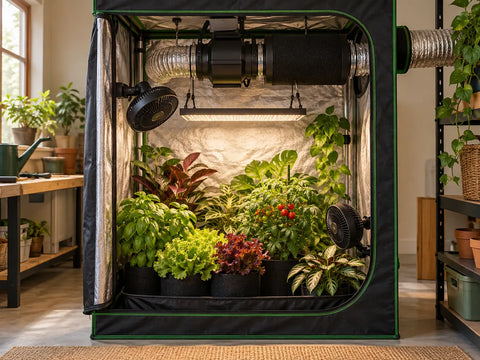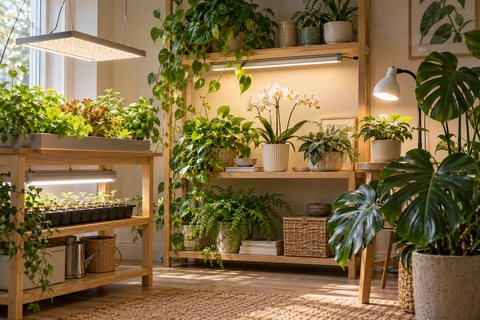
The short answer: choose a grow light that matches your plants, the shape of your growing area and the mounting space available. Panels are useful over grouped plants and growing tables. Bars fit shelves and longer planting areas. Bulbs work well for a focused plant corner. T5 fixtures offer linear lighting for trays and racks, with fluorescent and compatible LED options available.
For a monstera beside a window, the right solution may be very different from lighting a shelf of pothos, orchids or vegetable seedlings. Start with the space you want to illuminate, then compare fixture coverage and output rather than buying by wattage alone.
Why Indoor Plants May Need Extra Light
Shorter days and changing window light can leave an indoor growing area darker than it was in summer. Supplemental lighting can help fill that gap, especially where shelves, curtains or neighboring plants block daylight. Different species need different light levels; giving every plant the same exposure is rarely the best starting point.
Observe where new growth develops and whether plants lean toward a window. Record the available mounting height and how many plants need help before choosing equipment.
Panels, Bars, Bulbs and T5 Fixtures at a Glance
| Light style | A practical starting use | What to check |
|---|---|---|
| LED panels | Grouped plants, growing tables and compact indoor gardens | Coverage map, dimming, hanging height and support |
| LED bars | Plant shelves, racks and long or narrow growing areas | Length, bar spacing, mounting hardware and linking limits |
| Grow bulbs | A single plant or small group in a home interior | Socket compatibility, beam angle and lamp rating |
| T5 fixtures | Seedling trays and linear shelf layouts | Fluorescent versus LED, fixture length and replacement compatibility |
These are layout suggestions, not output ratings. A large bar fixture can be more powerful than a small panel, and two similar-looking bulbs can provide very different coverage.
LED Panels: Lighting a Group of Plants
Consider a panel when your plants occupy a square or rectangular footprint with open space overhead. Check the manufacturer's coverage information at the intended hanging height, including the edges rather than only the bright center.
A dimmable fixture gives you a convenient way to adjust output as the arrangement changes. Place plants with similar needs together and leave room to raise the light as they grow. For a mixed houseplant collection, avoid assuming that a high-output setting suitable for sun-loving herbs will suit every orchid or pothos.
Explore our LED grow light panels and compare the fixture's footprint with your actual growing area.
LED Bars: A Natural Fit for Plant Shelves
Bars are a useful option when the growing space is longer than it is wide. Under-shelf mounting keeps equipment integrated into the display and lets you plan lighting one shelf at a time.
Measure shelf depth as well as length. A single bar along the back may leave front-row plants poorly illuminated; compare the manufacturer's coverage guidance before deciding on placement or adding another bar.
Keep trailing pothos clear of the fixture and position taller plants so they do not shade smaller neighbors. Check whether a bar is designed as a primary light or supplemental light, and follow its connection limits if linking several units.
Browse LED grow light bars for shelving and other linear layouts.
Grow Bulbs: A Focused Option for Small Spaces
A grow bulb can be a straightforward choice for one plant or a small grouping. Before purchasing, check the bulb's base, electrical requirements and whether it is approved for the lamp or enclosure you intend to use.
Consider the beam direction. A shade that directs light away from the leaves can undermine an otherwise useful setup. Check coverage at the planned distance, and arrange the lamp so it is stable and comfortable to live beside.
Shop LED grow light bulbs for targeted supplemental lighting.
T5 Fixtures: Understand the Fixture and the Tube
T5 refers to a tube format, not a guarantee of brightness or spectrum. Traditional T5 fluorescent systems and LED products using the T5 format require different compatibility checks.
If you already own a fluorescent fixture, confirm the exact replacement tube recommended for that model. Matching length alone is not enough: some LED replacements are designed to work with specific ballasts, while others require different wiring. Follow the lamp and fixture instructions; never assume every T5 LED tube is interchangeable.
Compare our fluorescent grow light systems and LED T5 replacement tubes. Confirm whether the listing is for a complete fixture or a replacement lamp.
Compare Output, Coverage and Daily Light
Watts describe electricity consumption. They do not tell you how much light reaches a leaf. Lumens describe brightness for human vision, making them less useful for comparing plant lighting than suitable horticultural measurements.
PPFD describes the density of photosynthetic photons arriving at a surface. A coverage map measured at a stated height is more informative than a single center reading. Daily light exposure also depends on how long the light operates and how much daylight the plant receives.
When comparing products, ask for coverage data at the height you can actually use. For a shelf with low clearance, a fixture requiring substantial overhead space may be a poor fit even if its output is impressive.
Set Up Your Light in Five Steps
- Measure the growing area. Record width, depth, mounting clearance and space for future growth.
- Group plants thoughtfully. Separate plants with substantially different light requirements.
- Mount securely. Use approved hardware and follow electrical and moisture-rating instructions.
- Start with the manufacturer's placement guidance. Avoid applying one hanging-distance rule to every fixture.
- Use a consistent schedule and observe. A light timer makes daily operation easier. Keep a dark period and adjust for the species and existing daylight.
Common Indoor Lighting Mistakes
- Buying by wattage without checking coverage.
- Lighting a tall plant while leaving smaller plants in its shadow.
- Assuming a replacement tube includes the fixture.
- Ignoring socket, ballast or linking compatibility.
- Running lights continuously instead of following plant-specific schedules.
- Changing several settings at once and losing track of what helped.
Keep a simple record of fixture height, dimmer setting, timer schedule and plant placement. Change one factor at a time so your observations are useful.
Frequently Asked Questions
Which grow light is best for monstera and pothos?
Start with the layout. Bars may suit a shelf of smaller plants; a bulb or panel may suit a larger freestanding plant. Choose output and placement for the species and the daylight already available.
Do orchids need a different setup?
Orchids vary considerably by type. Identify yours first, then match light exposure to its needs. Do not treat all orchids as having the same requirements.
How close should a grow light be?
Use the fixture manufacturer's guidance and coverage information. There is no single safe or effective distance for every bulb, bar and panel.
Can I leave grow lights on all night?
Use a timer and preserve an appropriate dark period. Flowering responses can depend on day length, so check species-specific guidance rather than extending the schedule indefinitely.
Can I replace fluorescent T5 tubes with LEDs?
Only with a replacement approved for your fixture and ballast configuration. Confirm compatibility before purchasing or installing.
Find the Right Light for Your Growing Space
The best setup fits both the plants and the room. Choose a panel for a grouped growing area, bars for a shelf layout, bulbs for a focused corner or a compatible T5 system for linear trays.
Explore our panels, bars, bulbs and T5-style fixture options. Need help narrowing the choice? Call Garden Supply Guys at 920-857-9493 or visit our Green Bay store. Bring your measurements and a list of plants so our team can help you plan.
Sources and Further Reading
- University of Minnesota Extension — Lighting for indoor plants and starting seeds
- Iowa State University Extension — Growing Indoor Plants Under Supplemental Lights