The short answer: make sure herbs and flowers are fully dry and completely cool, place them in a clean airtight container, and store that container in a cool, dark, dry location. Glass makes inspection easy, while stainless steel blocks light and works well for larger batches. Humidity-control packs can help certain aromatic botanicals maintain a chosen texture, but they should never be used to rescue material that was sealed too wet.
Garden Supply Guys carries harvest storage supplies ranging from gasketed glass jars and stainless steel containers to Integra Boost two-way humidity-control packs. The best combination depends on what you are storing and how dry it should remain.
Important distinction: culinary herbs are typically dried until crisp and crumbly. Decorative flowers should also remain dry. A humidity pack is not automatically appropriate for either category. Use active humidity control only when the material, intended use and manufacturer guidance call for a specific equilibrium humidity.
What “Curing” Means for Herbs and Flowers
For dried herbs and flowers, curing is best understood as a brief quality-control and moisture-equalization stage after drying—not as a way to finish drying wet material. Moisture can remain unevenly distributed inside thicker stems, dense flower heads or a mixed batch. Once sealed, that hidden moisture migrates and may soften the material or appear as condensation.
Research-based home-preservation guidance says herbs are ready for packaging when leaves are crispy and crumble easily and stems break when bent. Let the dried material cool fully before it enters a container; warm material can create sweating inside the package.
Before Storage: Confirm the Material Is Fully Dry
Signs Culinary Herbs Are Ready
Leaves feel crisp and crumble readily between clean fingers.
Small stems break when bent rather than folding like fresh stems.
The batch has cooled to room temperature before packaging.
The aroma is clean and characteristic, with no musty, sour or fermented note.
Signs Dried Flowers Are Ready
Petals feel papery or crisp rather than cool, damp or flexible from moisture.
The thickest flower centers and stems are dry, not merely the outer petals.
Pieces do not release visible moisture when loosely enclosed for a short inspection period.
Separate edible herbs from decorative flowers and craft botanicals. Label non-food materials clearly, and use food-safe containers for anything intended for cooking or tea.
A Step-by-Step Conditioning and Storage Process
Finish drying first. Do not move damp centers into sealed storage.
Cool the batch completely. Packaging warm material can cause condensation.
Prepare the container. Wash as appropriate, dry every surface and inspect the gasket, lid and latch.
Keep pieces mostly whole. Crushing before storage increases exposed surface area and can accelerate aroma loss.
Fill gently. Use enough material to limit excess air without compressing or crushing delicate flowers.
Run a short inspection period. For the first 24–48 hours, check a clear test jar several times for condensation, unexpected softening or a musty odor.
Correct moisture immediately. If condensation appears or the batch softens noticeably, remove it and return it to the drying process. Discard anything moldy.
Label and store. Add the plant name, harvest date, drying date, intended use and any humidity pack used.
Choose the Right Storage Container
|
Option |
Best for |
Strength |
Watch for |
|
Clear glass jar |
Small batches, culinary herbs and frequent inspection |
Easy to see condensation and condition; nonreactive; reusable |
Light passes through, so store in a dark cabinet |
|
UV-blocking glass jar |
Aromatic botanicals displayed outside a closed cabinet |
Adds light protection while retaining visibility |
Still benefits from a cool, dark location |
|
Stainless steel container |
Larger batches and light-sensitive storage |
Opaque, durable, easy to clean and stack |
Condition cannot be seen without opening |
|
Humidity-controlled container |
Botanicals that require a defined RH range |
Combines an airtight seal with a pack holder or monitor |
Only useful after proper drying and with a suitable RH target |
Glass Jars: Best for Visibility
Glass is especially helpful during the first storage checks because moisture on the inside surface is easy to see. A gasketed clamp lid also makes opening and resealing straightforward. Keep clear jars in a dark cabinet or closed bin because light can fade color and degrade delicate aromatic compounds over time.
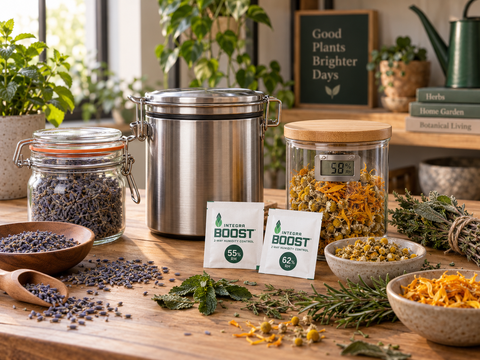
For a straightforward food-storage option, the Harvest Keeper 32-ounce glass jar uses a metal clamp lid and gasketed seal. The SmartJar curing and storage solution adds a built-in humidity sensor, silicone gasket and optional light-blocking glass for closer monitoring.
Stainless Steel: Best for Darkness and Larger Batches
Stainless steel naturally blocks light, resists breakage and suits larger harvests. Look for a smooth interior, a reliable sealing ring and clamps that pull the lid down evenly. Stainless steel is also convenient when containers must be moved frequently, but you will need to open the vessel to inspect the contents or use a compatible internal monitor.
The 33-liter stainless steel storage container uses a locking clamp and sealing ring to create an airtight closure, with welded side handles for moving larger batches. Choose a size that keeps the container reasonably full without compressing fragile material.
How to Use Humidity-Control Products Responsibly
Integra Boost packs are designed to absorb or release moisture inside a sealed container to maintain the RH printed on the pack. Garden Supply Guys carries both 55% and 62% options. Those numbers are product setpoints—not universal recommendations for every herb or flower.
|
Material or goal |
Starting approach |
Why |
|
Crisp culinary herbs |
Usually no active humidification |
Keep fully dry in an airtight container. Added humidity can soften herbs that should remain crisp. |
|
Decorative dried flowers |
Usually no active humidification |
Keep dry, dark and protected from crushing. Humidity can encourage fading, distortion or mold. |
|
Aromatic botanicals intended to remain slightly pliable |
Consider 55% RH when compatible |
A lower setpoint may help limit overdrying while maintaining a drier feel. Verify with a hygrometer. |
|
Aromatic botanicals with a validated 62% target |
Use 62% RH only when appropriate |
Monitor the sealed container closely and follow the product and botanical-specific guidance. |
For suitable aromatic botanicals, compare the Integra Boost 8g 55% pack with the Integra Boost 8g 62% pack. Match the pack size to the amount being stored, seal the container and replace the pack when its indicator or manufacturer instructions say it is spent.
Never add a humidity pack to material that is still damp or producing condensation.
Do not combine different RH packs in the same container.
Do not puncture, cut or wet the pack.
Use a reliable hygrometer when the stored material requires a defined RH range.
If an edible herb should remain brittle and crumbly, default to dry airtight storage rather than active humidification.
Protect Aroma, Color and Quality
Store cool. Heat accelerates quality loss, so avoid attics, garages, sunny shelves and cabinets beside appliances.
Store dark. Use a closed cabinet, opaque bin, UV-blocking jar or stainless container.
Limit openings. Each opening introduces fresh air and ambient humidity; portion large batches into smaller containers.
Leave herbs whole. Crumble or grind culinary herbs when you use them, not months in advance.
Use dry tools. A damp spoon or hand can introduce enough moisture to affect a small container.
Rotate inventory. Mark dates clearly and use the oldest properly stored batch first.
Research-based guidance gives a broad storage range of about four months to one year for dried foods, with cooler temperatures supporting longer quality. For home-dried herbs, plan to use the batch within a year and replace it sooner if color and aroma have faded.
Do You Need to “Burp” the Container?
Routine daily opening is not a substitute for complete drying. During the first one or two days, a brief inspection can reveal moisture migrating from thicker pieces. Once a batch is confirmed dry and stable, keep it sealed and open it only when needed. Repeated unnecessary opening exposes the contents to oxygen, ambient humidity and handling.
Troubleshooting Stored Herbs and Flowers
|
What you notice |
Likely cause |
What to do |
|
Condensation inside the jar |
Material was packaged warm or retained hidden moisture |
Remove it immediately and redry if there is no spoilage. Wash and fully dry the container before repacking. |
|
Material softens after sealing |
Moisture is equalizing from thicker pieces or room air entered |
Recheck the thickest pieces. Return the batch to drying if the texture should be crisp. |
|
Musty or sour odor |
Possible microbial growth or material sealed too wet |
Do not consume. Isolate and discard contaminated material; clean the container and nearby surfaces. |
|
Color fades quickly |
Light or heat exposure |
Move storage to a cooler, darker location or use opaque stainless steel or UV-blocking glass. |
|
Aroma disappears |
Frequent opening, grinding too early, heat or old material |
Store whole, divide large batches and minimize openings. |
|
Humidity will not stabilize |
Wrong pack size, poor seal, overly wet material or spent pack |
Check dryness and gasket first, then verify pack size and replacement status. |
|
Insects appear |
Contamination before or during packaging |
Discard affected material and inspect adjacent containers; clean the storage area thoroughly. |
Common Storage Mistakes
Sealing by calendar instead of confirming dryness in the thickest pieces.
Putting warm material into a closed jar or steel container.
Assuming a humidity pack can make under-dried material safe.
Using the same RH target for crisp culinary herbs, decorative flowers and pliable aromatic botanicals.
Leaving clear jars in sunlight or near a heat source.
Grinding the entire batch before storage.
Opening one large container every day instead of dividing the batch into working portions.
Ignoring a damaged gasket, warped lid or incomplete latch.
Frequently Asked Questions
How do I know dried herbs are ready for a jar?
Leaves should be crispy and crumble easily, stems should break when bent, and the batch should be fully cool. If a closed test jar develops condensation or the material becomes soft, return it to drying.
Are glass or stainless steel containers better?
Neither is universally better. Glass is ideal for visual inspection and small batches; stainless steel blocks light, resists breakage and works well for larger quantities. The lid and gasket matter as much as the container material.
Should I choose a 55% or 62% humidity pack?
Choose only after deciding whether the botanical should remain crisp or slightly pliable. Crisp culinary herbs and most decorative dried flowers generally do not need active humidification. For suitable aromatic botanicals, 55% provides a drier target than 62%; follow the product and material-specific guidance.
Can humidity packs prevent mold?
They can help stabilize a properly dried product inside a well-sealed container, but they do not sterilize material or make wet botanicals safe. Proper drying, clean packaging and inspection remain essential.
How full should the container be?
Fill enough to reduce excess air space, but do not compress delicate flowers or prevent inspection. For a large harvest, several smaller containers usually protect quality better than one container opened repeatedly.
How long will dried herbs keep?
Quality varies with plant type, dryness, temperature, light and how often the container is opened. Label the date, aim to use home-dried herbs within about a year, and replace them earlier if their color or aroma has faded.
What should I do if I see mold?
Do not smell closely, taste or consume the material. Seal and discard the affected batch, inspect nearby containers and thoroughly clean the storage area. Redrying is not a safe repair for visibly moldy food.
Build a Better Storage System
A dependable system is simple: dry completely, cool fully, choose a clean airtight container, monitor the first storage period and protect the batch from heat, light and repeated air exposure.
Explore Garden Supply Guys’ harvest storage supplies for glass jars, stainless steel containers and Integra Boost humidity-control products, or review our harvest drying supplies if the batch still needs more time before storage.
Sources and Further Reading
National Center for Home Food Preservation — Herbs
National Center for Home Food Preservation — Packaging and Storing Dried Foods