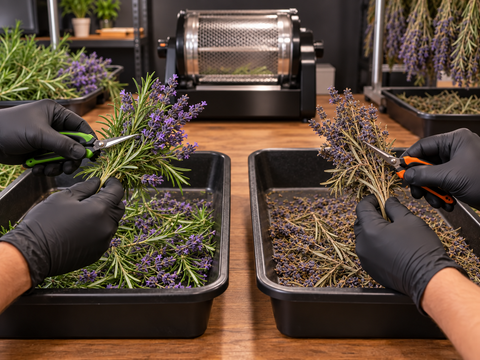
The short answer: neither wet trimming nor dry trimming is automatically better for every harvest. Wet trimming removes leaves before drying, while they are still soft and easy to see. Dry trimming leaves more material attached during the dry and finishes the detailed work afterward. The better choice depends on your room humidity, drying speed, available space, harvest size and preferred workflow.
For many home growers, a mild hybrid method is the most forgiving starting point: remove large fan leaves and any damaged material at harvest, hang manageable branches with some smaller leaves intact, then complete the close trim after drying. This reduces bulky leaf mass without forcing the entire trimming job into harvest day.
Whichever method you choose, prepare clean, sharp trimming scissors, a stable trim tray or harvest workstation, and - for a larger run - an appropriately sized harvest trimmer.
Safety and legality note: Follow all applicable laws. Work only with clean, lawfully grown crops. Isolate and discard material showing mold, rot, pest contamination or a musty odor, and sanitize tools and work surfaces. Trimming cannot make contaminated plant material safe.
What Wet and Dry Trimming Mean
Trimming removes unwanted fan leaves, smaller leaf tips and excess stem from harvested flowering material. The difference is simply when the detailed trimming happens.
· Wet trimming: Most leaf removal and shaping happen immediately after harvest, before branches or flowers enter the drying space.
· Dry trimming: Large or damaged leaves may be removed first, but detailed trimming waits until the material has dried.
· Hybrid trimming: Large fan leaves come off fresh; smaller protective leaves remain during drying and are cleaned up afterward.
Wet Trimming
Advantages of Wet Trimming
· Fresh leaves remain extended, making stems and cut lines easier to see.
· Soft leaves are usually easier to position and cut with precision scissors.
· Removing leaf mass before hanging can increase air access and speed drying.
· Trimmed pieces take up less room on drying racks or lines.
· The finished shape is established before the material becomes brittle.
Limitations of Wet Trimming
· Harvest day becomes longer and more labor intensive.
· Fresh resin and plant sap can make scissors sticky, so several clean pairs or regular blade cleaning may be needed.
· Removing too much protective leaf can make material dry faster than intended in a warm or low-humidity room.
· Fresh material may smear or compress in a trimmer that is not designed for wet use.
Wet Trimming Is Often a Good Fit When
· Your drying room tends to run humid and you need to reduce dense leaf mass.
· Drying space is limited.
· You have enough help and time on harvest day.
· Your crop has an open structure and can be handled gently without crowding.
Dry Trimming
Advantages of Dry Trimming
· Leaving branches and smaller leaves intact can slow moisture loss in a dry climate or strongly conditioned room.
· Detailed trimming can be scheduled after harvest day instead of all at once.
· Dry outer leaves can help shield delicate flower surfaces during hanging and handling.
· In one controlled 2024 study of a single cultivar, post-dry trimming retained the highest terpene concentration among the three methods tested.
Limitations of Dry Trimming
· Dry leaves curl inward and may be slower to remove cleanly.
· Brittle material and dried surface structures can break off more easily during rough handling.
· Whole branches and attached leaves require more drying-room space.
· Dense material needs careful spacing, humidity control and inspection so moisture does not remain trapped.
Dry Trimming Is Often a Good Fit When
· Your environment is naturally dry or your drying system removes moisture quickly.
· You want to spread labor over several days.
· You have adequate hanging space and strong control over temperature, humidity and indirect airflow.
· A slower dry and careful preservation of aroma are higher priorities than speed.
Wet Trim vs. Dry Trim at a Glance
|
Factor |
Wet trimming |
Dry trimming |
|
Detailed trim |
Before drying |
After drying |
|
Leaf condition |
Soft and extended |
Dry, curled and more brittle |
|
Drying pace |
Usually faster because leaf mass is reduced |
Usually slower when branches and leaves remain intact |
|
Space needed |
Less |
More |
|
Labor timing |
Concentrated on harvest day |
Split between harvest and post-dry cleanup |
|
Main handling concern |
Sticky tools and over-fast drying |
Breakage and harder-to-reach curled leaves |
|
Often suits |
Humid rooms, limited space, small organized batches |
Dry rooms, ample hanging space, staggered labor |
What the Research Actually Says
Direct research comparing trimming methods is limited. A 2024 controlled study evaluated mild pre-dry trimming, aggressive pre-dry trimming and post-dry trimming on one commercially available hybrid cultivar. Mild pre-dry trimming produced the highest cannabinoid concentration in that test, while post-dry trimming retained the highest terpene concentration.
That result is useful, but it is not proof that one method will always produce stronger or more aromatic material. The researchers tested one cultivar under one drying protocol. Plant structure, maturity, room conditions, handling and the aggressiveness of the trim can all change the outcome. Treat the study as evidence that timing and trim intensity matter - not as a universal winner.
The broader post-harvest literature consistently emphasizes environmental control. Regardless of trimming style, a stable drying room, appropriate humidity, indirect airflow, cleanliness and careful handling are more dependable quality controls than simply choosing wet or dry trimming.
The Hybrid Method: A Practical Middle Ground
A hybrid trim keeps the easiest parts of both workflows and is often a sensible default for a first harvest or an unfamiliar drying room.
1. Inspect first. Remove any material with mold, rot, pests or questionable odor before it reaches the drying space.
2. Remove large fan leaves. Take off leaves with long exposed stems and anything that blocks airflow through a dense branch.
3. Leave smaller protective leaves. Retain enough material to moderate drying without creating packed, wet centers.
4. Hang manageable branches. Leave visible space between them and use gentle indirect airflow.
5. Finish after drying. Use sharp scissors over a trim tray when the exterior is dry but the material is not brittle or crumbling.
Choose Based on Your Drying Room
|
Your situation |
Practical direction |
|
Room stays humid |
Lean toward wet or hybrid trimming; reduce dense leaf mass and improve spacing. |
|
Room dries too quickly |
Lean toward dry or mild hybrid trimming; keep branches larger and avoid direct fan exposure. |
|
Hanging space is tight |
Wet trimming reduces volume before material enters the room. |
|
Harvest is large |
Split the crop into manageable batches; consider a compatible trimmer and plan labor before cutting. |
|
Aroma preservation is the priority |
Favor slower, controlled drying and gentle handling; dry trimming may be worth testing. |
|
It is your first run in the room |
Use a mild hybrid and document temperature, RH, drying time and results before changing the next batch. |
Manual Scissors, Trim Trays or Harvest Trimmers?
Trimming Scissors
Sharp, comfortable trimming scissors and hand tools offer the most control for selective cuts and small or premium batches. Curved blades can follow rounded surfaces, while straight blades are useful for stems and precise access. Keep a second clean pair ready and follow the tool maker's cleaning directions.
Trim Trays and Workstations
A stable trim tray or harvest workstation keeps tools, cut leaves and finished material separated. Raised sides reduce spills, and a removable screen can help keep small plant particles out of the main work area. Work in shallow batches so nothing is crushed beneath a pile.
Harvest Trimmers
For larger crops, a properly selected harvest trimmer can reduce labor substantially. Confirm whether the model is intended for wet material, dry material or both. Feed small, consistent batches, avoid overfilling and inspect the result frequently. Machine trimming trades some individual control for speed, so follow the manufacturer's operating, cleaning and safety instructions.
Step-by-Step Wet Trimming Workflow
1. Prepare the room and tools. Sanitize surfaces, sharpen or replace blades, and set up trays before cutting plants.
2. Inspect the crop. Remove contaminated or damaged material rather than trimming it into the finished batch.
3. Remove fan leaves first. Hold the branch by the stem and avoid squeezing flower surfaces.
4. Make selective close cuts. Remove protruding leaf material without cutting deeply into the flower structure.
5. Clean sticky blades. Rotate clean scissors as needed so cuts remain controlled.
6. Move immediately to drying. Space pieces evenly and watch RH closely because reduced leaf mass can accelerate moisture loss.
Step-by-Step Dry Trimming Workflow
1. Inspect and make a light pre-trim. Remove damaged material and large fan leaves that would block airflow.
2. Hang branches with space. Do not let dense pieces press against each other or a wall.
3. Control the dry. Monitor temperature, relative humidity and indirect airflow rather than relying on a fixed number of days.
4. Check readiness in several locations. Outside material should feel dry, but not crumble under light handling.
5. Trim over a tray. Hold stems instead of finished surfaces and remove curled leaves with small, deliberate cuts.
6. Move to appropriate storage only after moisture is uniform. Recheck for damp centers and off odors before sealing.
Troubleshooting Common Trimming Problems
|
What you notice |
Likely cause |
What to do |
|
Scissors gum up quickly |
Fresh resin and sap on wet material |
Rotate clean tools and clean blades according to the manufacturer's instructions. |
|
Wet-trimmed material dries too fast |
Too much leaf removed, low RH, heat or direct airflow |
Redirect fans, stabilize the room and retain more protective leaf on the next batch. |
|
Dry leaves curl into the flowers |
Detailed trimming was delayed until material became very dry |
Trim slightly earlier next time and use fine-tip scissors for curled edges. |
|
Material crumbles during trimming |
Over-drying or rough handling |
Reduce handling, correct storage only when moisture is uniform and slow the next dry. |
|
Centers smell musty or feel damp |
Crowding, high RH or inadequate air exchange |
Isolate and inspect immediately; discard contamination and sanitize the area. |
|
A machine smears or bruises material |
Wrong wet/dry setting, overfilled drum or excessive run time |
Stop, verify the manual and test smaller consistent batches before continuing. |
|
Finish looks uneven |
Mixed branch sizes or inconsistent feeding and handling |
Sort by size and structure before trimming, and inspect at regular intervals. |
Frequently Asked Questions
Which method is faster?
Wet trimming is often faster for each individual cut because fresh leaves are extended and easy to see. It also removes leaf mass before drying. However, it concentrates the work on harvest day. Dry trimming spreads the labor out but may take longer per piece because dry leaves curl inward.
Does dry trimming preserve more terpenes?
One controlled 2024 study found the highest terpene concentration in its post-dry-trim group, but it evaluated one cultivar under one protocol. That is promising evidence, not a guarantee. Genetics, harvest maturity, drying conditions, trim intensity and handling also matter.
Is wet trimming better in a humid climate?
It can help by reducing leaf mass and increasing access to drying air, but it does not replace humidity control, spacing, sanitation or inspection. A poorly controlled wet-trimmed batch can still dry unevenly or develop microbial problems.
Can I combine wet and dry trimming?
Yes. Removing fan leaves fresh and completing the close trim after drying is a common and practical hybrid. It reduces bulk while preserving some of the slower-drying effect of attached branches and smaller leaves.
Can one mechanical trimmer process both wet and dry material?
Only if the manufacturer specifies that the model, blade or configuration supports both. Wet and dry material behave differently, so verify settings, batch size, preparation and cleaning instructions in the product manual.
What is the best method for a first harvest?
A mild hybrid is often the easiest starting point: remove fan leaves and obvious protruding material fresh, dry well-spaced branches under stable conditions, then finish by hand over a tray. Record your room conditions and result so the next batch can be adjusted deliberately.
Choose the Workflow That Fits Your Harvest
Wet trimming offers visibility, compact drying and a front-loaded workflow. Dry trimming can slow moisture loss, spread out the labor and may better protect aroma in some conditions. A hybrid provides flexibility when you are still learning how your crop and drying room behave.
Set up before harvest day with clean trimming scissors, a comfortable selection of trim trays and harvest supplies, or a suitable harvest trimmer. Start with a small batch, document the result and let your actual room conditions guide the next decision.
Sources and Further Reading
· Oregon State University Extension - Post-harvest processing of hemp flowers