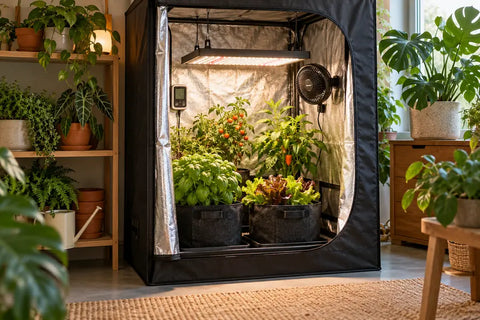
The short answer: choose a grow tent around the mature canopy you want to maintain, then confirm that the tent also has enough height for containers, lights, ventilation equipment, and safe working clearance. Plant count is useful as a starting point, but it should not be the only number guiding your decision.
For many home growers, a 2x2 or 2x4 tent is a manageable first setup. A 3x3 offers a little more flexibility, while 4x4 and 5x5 tents create room for a broader canopy and more equipment. Larger tents such as 4x8, 5x10, 8x8, and 10x10 are best treated as small indoor rooms: they require deliberate lighting, airflow, access, and environmental planning.
This guide walks through the decision in the order that matters most—canopy, height, light, airflow, access, and room conditions—then matches those needs to the AC Infinity tent sizes available from Garden Supply Guys.
The Fastest Way to Choose a Grow Tent Size
Define your mature canopy. Estimate the final width and depth of the plant area after spacing, training, and branching—not the size of young plants today.
Match the light to that footprint. Use the fixture manufacturer's coverage guidance for your crop and growth stage. A larger tent does not compensate for a light that cannot cover its canopy evenly.
Build a vertical budget. Subtract the height of containers or a hydroponic system, the fixture and hangers, exhaust equipment, and the recommended light-to-canopy distance from the tent's total height.
Reserve room to work. You still need to water, inspect, prune, clean, and reach the plants in the back without damaging the canopy.
Plan the environment. Confirm that the surrounding room can handle the tent's heat, humidity, noise, and exhausted air.
Grow Tent Size Chart: Where Each Footprint Fits
The chart below uses current AC Infinity tents and complete systems carried by Garden Supply Guys as reference points. Plant counts are approximate. A single wide, heavily trained plant can fill the same canopy as several smaller plants.
|
Tent size |
AC Infinity examples |
Often fits best when… |
Watch for… |
|
2x2 |
CLOUDLAB 422 or 722; 1-plant complete kit |
You want one compact canopy, a small tropical-plant zone, or a contained starter setup. |
The 48-inch model has limited vertical margin; the 72-inch model is more forgiving. |
|
2x4 |
CLOUDLAB 642; 2-plant complete kit |
You have a narrow room, want side-by-side plants, or prefer reaching everything from one long door. |
Use a rectangular light designed for a 2x4 footprint. |
|
3x3 |
CLOUDLAB 733; 3-plant complete kit |
You want a balanced square footprint with more room than a 2x2 but modest room demands. |
Center access matters as the canopy fills the full square. |
|
4x4 |
4-plant complete and PRO kits |
You want a common full-cycle footprint with room for a broad, evenly trained canopy. |
Heat, humidity, and total fixture output rise noticeably from compact setups. |
|
5x5 |
CLOUDLAB 866; 6-plant PRO kit |
You want more canopy flexibility or space around larger containers and equipment. |
Make sure the room and ventilation system can manage the larger environmental load. |
|
4x8–10x10 |
CLOUDLAB 894, 816, 899, and 811 |
You are planning a multi-light room-scale grow with defined access and equipment zones. |
Plan circuits, cooling, dehumidification, drainage, and walkways before buying. |
|
Multi-chamber |
CLOUDLAB 632D, 743D, and 864D |
You want separate seedling, propagation, vegetative, or flowering areas in one footprint. |
Each chamber needs compatible light, airflow, and temperature planning. |
Start With Mature Canopy, Not Plant Count
Plant count can be misleading because plants do not finish at one standard size. Genetics, crop type, container volume, vegetative time, pruning, trellising, and training style can all change the final canopy.
A better method is to sketch the canopy footprint you intend to maintain. Include a little separation between plants so air can move through the foliage. If you plan to train branches horizontally or use a trellis, size the tent for that expanded canopy rather than the original pot spacing.
For one contained growing zone: a 2x2 is often enough if the crop stays compact and the light is matched to the footprint.
For a narrow, efficient layout: a 2x4 makes good use of a wall and keeps most of the canopy within easy reach.
For a flexible square layout: a 3x3 offers noticeably more working room than a 2x2 without the environmental demand of a 4x4.
For a broader home setup: a 4x4 or 5x5 supports a larger trained canopy, but it also requires more light and stronger environmental control.
If you are deciding between two sizes, do not automatically choose the larger tent. Choose the footprint your light can cover properly and your room can condition reliably. An efficiently filled smaller tent often performs better than an oversized tent with weak light or uneven airflow.
Do the Vertical-Clearance Math
Tent height is easy to overlook because shoppers naturally focus on floor space. Your plants, however, only receive the height left after every other component is installed.
Use this simple planning equation:
Usable plant height = tent height − container/system height − light and hangers − required light clearance − equipment margin
Follow the light manufacturer's hanging-height recommendations and remember that exhaust fans, filters, ducting, sensors, and support bars may occupy the upper portion of the tent. Compact 48-inch tents can work very well for seedlings, propagation, short crops, or carefully controlled plants, but a 72- or 80-inch tent gives most full-cycle growers more room to react when plants stretch.
Measure the Room Around the Tent
The listed tent dimensions describe the enclosure—not the clearance needed to assemble and use it. Measure the room before ordering, then account for:
Ceiling clearance for lifting poles into place and routing ducting
Space for doors to unzip and fold away
Room behind or beside the tent for cords, ducts, controllers, and intake air
A clear path from the delivery point to the final location
Access to electrical outlets without unsafe extension-cord arrangements
A practical route for removing water, runoff, and equipment during cleaning
Large tents deserve extra attention. A tent may technically fit wall to wall but still be frustrating to maintain if one side becomes inaccessible. In an 8x8 or 10x10 setup, plan how you will reach the center before the canopy fills in.
Match the Grow Light to the Tent
Tent and light should be selected as a pair. Check the fixture's recommended coverage for the crop and growth stage you intend to run. A fixture promoted for vegetative coverage may cover a larger area than it can support at a higher-light stage.
Square tents usually pair most naturally with square fixtures or bar-style lights designed for an even square footprint.
A 2x4 tent typically benefits from a rectangular fixture or two coordinated fixtures that distribute light along the full length.
Large tents normally require multiple fixtures and careful overlap to prevent dim edges and intense hot spots.
Multi-chamber tents need separate lighting plans for the main chamber and smaller shelves or side chamber.
Leave enough adjustment range above the canopy to raise or dim the light as plants develop. If the fixture nearly fills the tent ceiling, confirm that there is still room for hangers, exhaust components, and safe airflow around the light.
Plan Ventilation Before You Upsize
A larger tent contains more air, usually carries more plant material, and often uses more lighting. All three increase the demand on the exhaust system and on the surrounding room.
Begin by calculating tent volume:
Length × width × height = cubic feet
That volume is only the starting point for fan selection. Carbon filters, long duct runs, tight bends, hot lights, and a warm or humid room can reduce effective airflow or increase the amount of air exchange needed. Choose an inline fan with usable reserve capacity and pair it with appropriately sized ducting. Use circulation fans inside the tent to move air gently above, below, and through the canopy; they do not replace the exhaust system.
Also decide where exhausted air will go. Venting warm, humid air into the same closed room can cause the tent to draw that moisture and heat right back in. The larger the tent, the more important the lung room becomes.
Compact, Mid-Size, Large, or Multi-Chamber?
Compact tents: 2x2 and 2x4
Compact tents are well suited to first-time indoor growers, limited rooms, small specialty crops, tropical-plant care, propagation, and focused experiments. Garden Supply Guys currently lists AC Infinity 2x2 options in both 48- and 72-inch heights, a 2x4 CLOUDLAB 642, complete 2x2 and 2x4 systems, and a low-profile propagation tent with shelving support.
Choose the taller version if you expect meaningful vertical growth or want more freedom to place the exhaust system overhead. Choose the shorter propagation format when the goal is trays, clones, seedlings, mushroom work, or tiered shelves rather than tall mature plants.
Mid-size tents: 3x3, 4x4, and 5x5
These sizes suit growers who want a larger full-cycle canopy without turning the setup into a room-scale project. The 3x3 CLOUDLAB 733 is a balanced step up from compact tents. AC Infinity complete systems add 4x4 options, while the CLOUDLAB 866 and 5x5 PRO system serve growers who want additional canopy and equipment space.
The main tradeoff is environmental load. Compared with a 2x2, these tents usually need more lighting, more exhaust capacity, more circulation, and a better plan for room heat and humidity.
Large tents: 4x8, 5x10, 8x8, and 10x10
Large tents are best for experienced growers who are ready to plan multiple lights, stronger ventilation, electrical demand, dehumidification, and interior access. The AC Infinity large-tent collection includes long rectangular and square room-scale footprints. Availability can change, so use the collection page to see the current lineup.
Before choosing one, map the equipment and walking paths on the floor with painter's tape. Confirm that you can reach every plant and remove every container. If the plan only works while the tent is empty, the tent is too large for the room or needs a different interior layout.
Multi-chamber tents: separate stages in one footprint
AC Infinity CLOUDLAB 2-in-1 tents divide the enclosure into a main growing chamber and a smaller area that can support propagation, seedlings, or a different stage. Garden Supply Guys currently lists 3x2, 4x3, and 5x4 multi-chamber models.
A multi-chamber tent can make excellent use of limited space, but it is not automatically simpler. Each chamber still needs suitable lighting and air movement, and the two zones may not want the same temperature, humidity, or light schedule. Choose this format when the separation solves a real workflow need.
Tent Only or a Complete Grow Tent Kit?
A tent-only setup gives you maximum freedom to select the exact light, exhaust fan, filter, controls, and accessories you want. It is often the better route when you already own equipment or have specialized environmental requirements.
A complete AC Infinity grow tent system can simplify compatibility. The current Garden Supply Guys lineup spans 2x2, 2x4, 3x3, 4x4, and 5x5 systems, with the product names providing an approximate plant capacity. Kits are especially useful when you want coordinated controls and do not want to size every major component independently.
Choose tent-only when you already have compatible gear, want a custom light or ventilation design, or expect to upgrade components individually.
Choose a complete kit when you value a coordinated package, easier setup, and a clearer starting point for light and airflow capacity.
Common Grow Tent Sizing Mistakes
Buying by seedling size. Plan for the mature, trained canopy rather than the space young plants occupy today.
Using plant count as a guarantee. Plant counts are estimates; one large trained plant may use the same floor area as several smaller plants.
Ignoring height. Containers, lights, filters, fans, and safe light clearance can consume much of the advertised tent height.
Upsizing without upgrading the light. Dark corners and uneven intensity are difficult to correct after the canopy is full.
Filling every square inch with foliage. Leave enough room for airflow, inspection, watering, pruning, and cleaning.
Forgetting the surrounding room. A tent can only exchange heat and moisture with the space around it unless exhaust is routed elsewhere.
Choosing a large tent for future growth without a phased plan. An oversized setup costs more to light and condition. Expand when the current system and room can support it.
A Simple Pre-Purchase Checklist
I measured the room, ceiling, doors, and delivery path.
I estimated mature canopy width and depth after training.
My light is rated for the planned footprint and growth stage.
I calculated usable plant height after subtracting every overhead and root-zone component.
I can reach the back and center of the canopy for routine care.
My exhaust fan, filter, ducting, and circulation plan match the tent volume and heat load.
The surrounding room can manage the exhausted heat and humidity.
The electrical load is appropriate for the circuit and equipment instructions.
I know whether a tent-only build or complete system is the better value for my situation.
Frequently Asked Questions
Is a 2x2 grow tent big enough for a beginner?
Often, yes. A 2x2 is economical to light and ventilate, and it keeps the first setup manageable. Choose a 72-inch-tall model if you want more vertical flexibility; a 48-inch model is better suited to short crops, propagation, or carefully controlled plant height.
Should I buy a 2x4 or a 3x3 grow tent?
Both offer useful mid-compact footprints. A 2x4 fits naturally along a wall and provides easy side-to-side access. A 3x3 offers a square canopy and slightly more floor area. Let the room shape, light coverage, and preferred access pattern decide.
Is a 4x4 grow tent too large for a first setup?
Not necessarily, but it requires more planning and equipment than a 2x2 or 2x4. Make sure you are comfortable managing the light, exhaust, humidity, watering volume, and access needs of the larger canopy.
How tall should my grow tent be?
For many full-cycle gardens, 72 to 80 inches is easier to work with than 48 inches. The correct height depends on the container or hydroponic system, plant structure, fixture thickness, hangers, required light distance, and overhead ventilation equipment.
Do I need a larger tent if I add a carbon filter?
Not always, but the filter and fan consume space—often near the ceiling—and add resistance to airflow. Include both in your vertical and ventilation calculations. In a very short tent, placing some ventilation components outside the enclosure may preserve plant height if the equipment instructions allow it.
When is a multi-chamber tent the best choice?
Choose a multi-chamber tent when you genuinely need separate spaces for propagation, seedlings, vegetative growth, or another stage but only have room for one enclosure. Confirm that each chamber can receive the light, airflow, and environmental conditions it needs.
Choose the Smallest Tent That Fully Supports the Plan
The best grow tent is not the biggest model that fits the room. It is the smallest tent that comfortably supports your mature canopy, light coverage, vertical stack, airflow, and maintenance routine—with enough reserve space to keep the garden manageable.
Ready to compare options? Shop all grow tents and accessories, then narrow the selection by compact, mid-size, large, multi-chamber, or complete grow tent systems.
Sources and Further Reading
AC Infinity — Indoor Grow Space
AC Infinity — Advance Grow Tents
AC Infinity — How to Calculate Required CFM for a Grow Tent